
“What stood out was the amount of thought that went into the structure
before the website work moved forward. We have a fairly complex range
of services, and simply making the site look better would not have
solved the underlying problem.The team took time to understand how the different areas of the
business related to each other and how clients needed to move through
the website. Communication was clear throughout, and the decisions
felt based on what the business actually needed rather than adding
features for the sake of it.”
Bespoke Website Design for Businesses That Need More Than a Standard Website
When your website needs to reflect a specific business structure, customer journey or way of presenting information, a standard template can start to become a constraint. Prime Lion Digital provides bespoke website design for UK businesses that need greater control over how their website is structured, experienced and presented.
We define the architecture, user journeys, page hierarchy and interface around the actual requirements of the project — while keeping standard approaches where they already do the job well.
Discuss Your Bespoke Website | View Our Website Work
Let's Discuss Your Project
Tell us a little about what you’re looking for, and our team will be in touch to discuss how we can help.
Different Businesses Need Different Website Structures
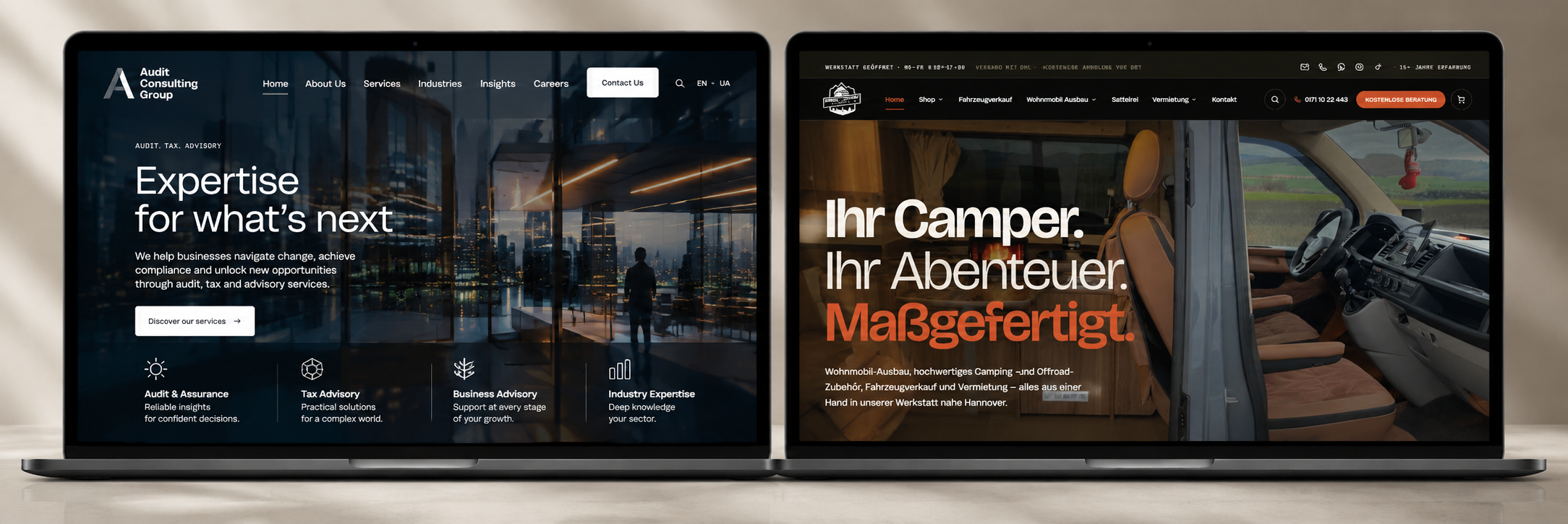
Freizeit Camper
The Freizeit Camper project brings products, services and informational content into one commercial website experience. The design needs to help visitors move between different types of content without making the website feel fragmented.
Audit Consulting Group
Audit Consulting Group has a different requirement. Its website needs to organise a broad professional-services offering and supporting content so users can understand where they are, find the relevant service and move towards an enquiry.
The visual language and structure are different because the underlying requirements are different. That is the practical role of bespoke design.
What Actually Needs to Be Bespoke?
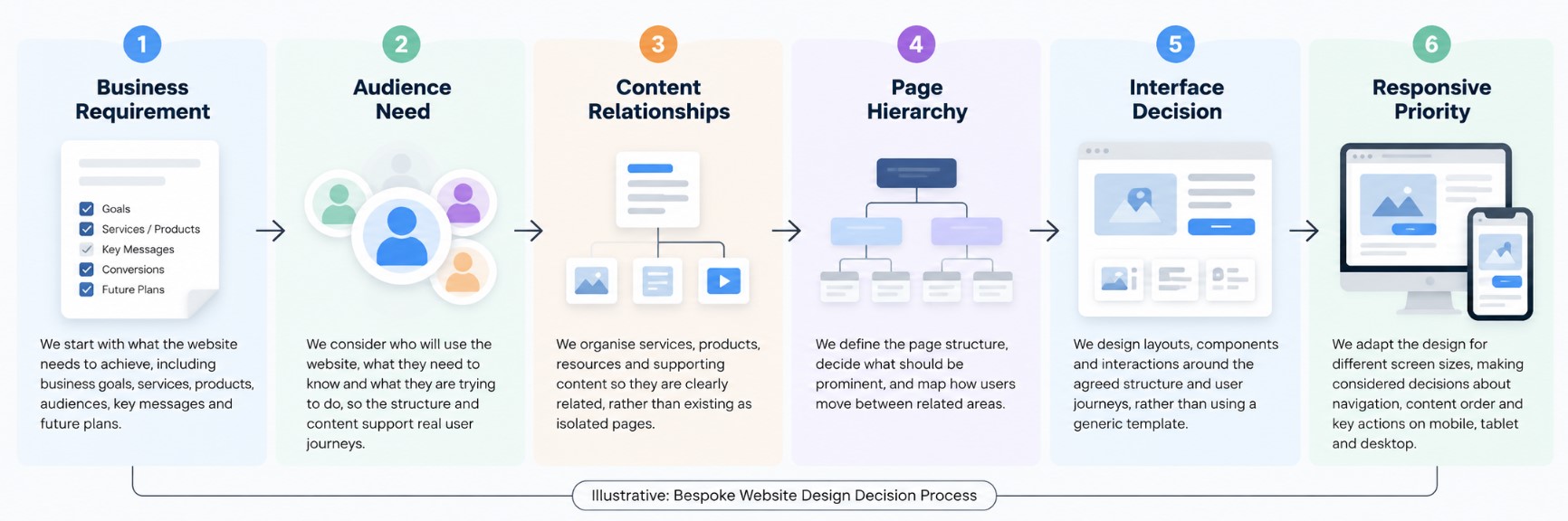
Business requirement
We start with what the website needs to support: the services, products, audiences, content and actions that matter to the business.
Audience need
Different users may arrive with different levels of knowledge and different objectives. Those differences influence how information should be organised and presented.
Content relationships
Services, products, resources, case studies and supporting information need clear relationships rather than being treated as isolated pages.
Page hierarchy
We decide which information deserves prominence, what belongs deeper in the journey and how users should move between related areas.
Interface decisions
Layouts, components, calls to action and visual emphasis are then designed around that hierarchy rather than chosen simply because they are available in a template.
Responsive priority
The same priorities are considered for smaller screens, where navigation, content order and interaction often need more deliberate decisions.
When Does Bespoke Website Design Make Sense?
Your website structure no longer reflects your business
You may have added services, audiences or content over time and reached a point where the existing navigation and page structure no longer communicate the business clearly.
Different audiences need different journeys
If customers arrive with substantially different needs, a single generic journey may not provide enough guidance.
Your content keeps being forced into unsuitable layouts
Templates can work well when their structure matches the content. They become restrictive when important information repeatedly has to be shortened, rearranged or compromised to fit predefined layouts.
Your commercial requirements need a more deliberate interface
Specific enquiry routes, content relationships, product/service combinations or functionality may require design decisions that a standard website structure does not handle cleanly.
Designing Complex Service Information Around the User
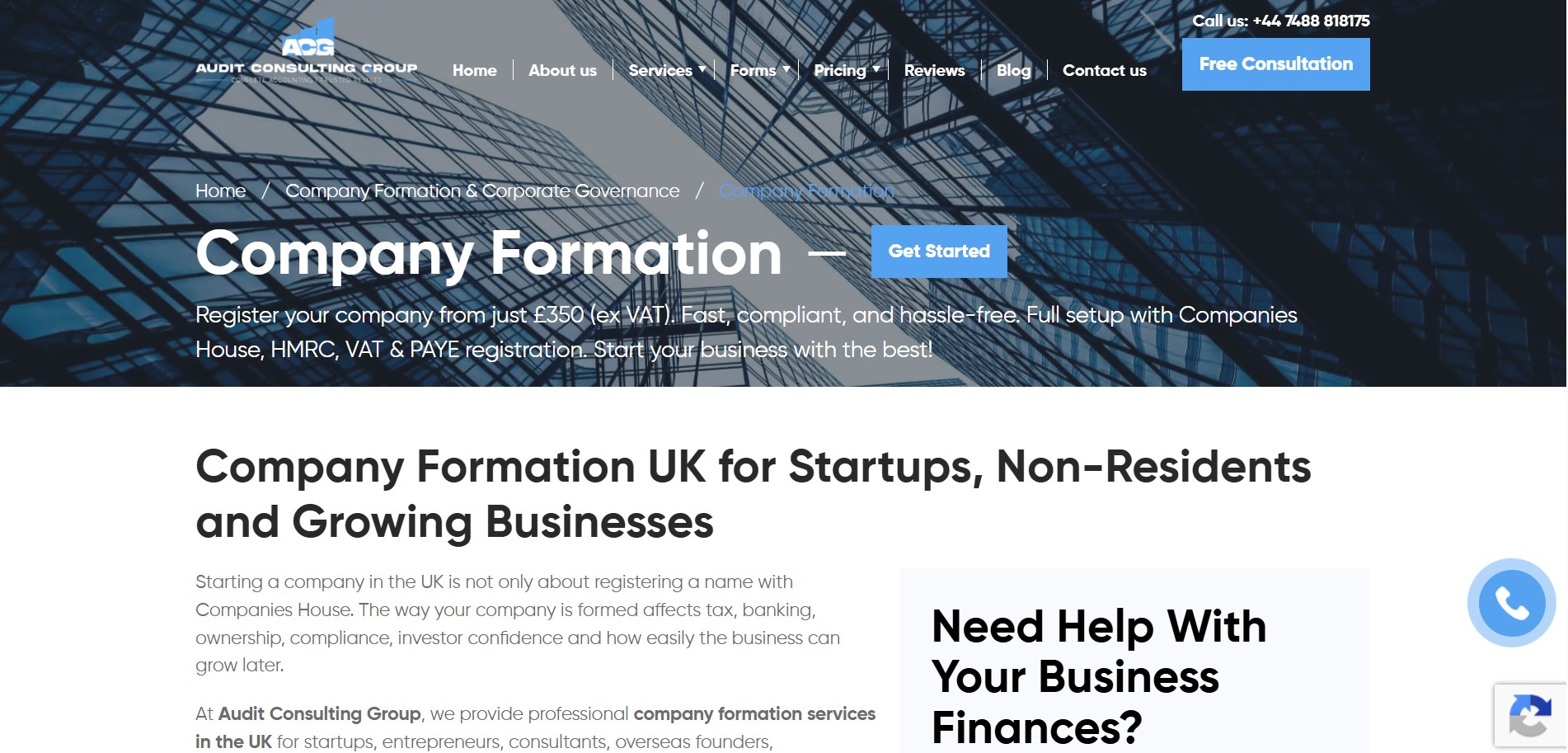 What to notice: the design has to help users understand where individual services sit within a broader offering and provide sensible routes between commercial and supporting information.
Why it matters: on content-rich service websites, hierarchy is part of the user experience. A visually polished page cannot compensate for an underlying structure that is difficult to understand.
What Our Bespoke Website Design Service Can Include
Information Architecture
We organise pages and content around the relationships users need to understand, creating a clearer foundation for navigation and future content.
User Journeys
We consider how different visitors enter the website, what information they need and which actions should logically follow.
Wireframes
Where appropriate, wireframes help establish hierarchy, page flow and functional requirements before visual detail is introduced.
Bespoke UX and UI Design
Page layouts and interface components can be designed specifically around the approved structure, content and brand rather than being selected from a predefined template.
Responsive Design
Desktop and mobile experiences are considered according to their available space, navigation requirements and content priorities.
Reusable Components
Where the project benefits from them, reusable interface components can provide consistency without forcing unrelated content into identical layouts.
Implementation
Where development is included in the agreed scope, the approved designs can be implemented as part of the wider website project. CMS configuration, ecommerce, integrations, migration and custom functionality depend on the requirements of the individual project.
Responsive Design Is About Priority, Not Simply Shrinking the Desktop
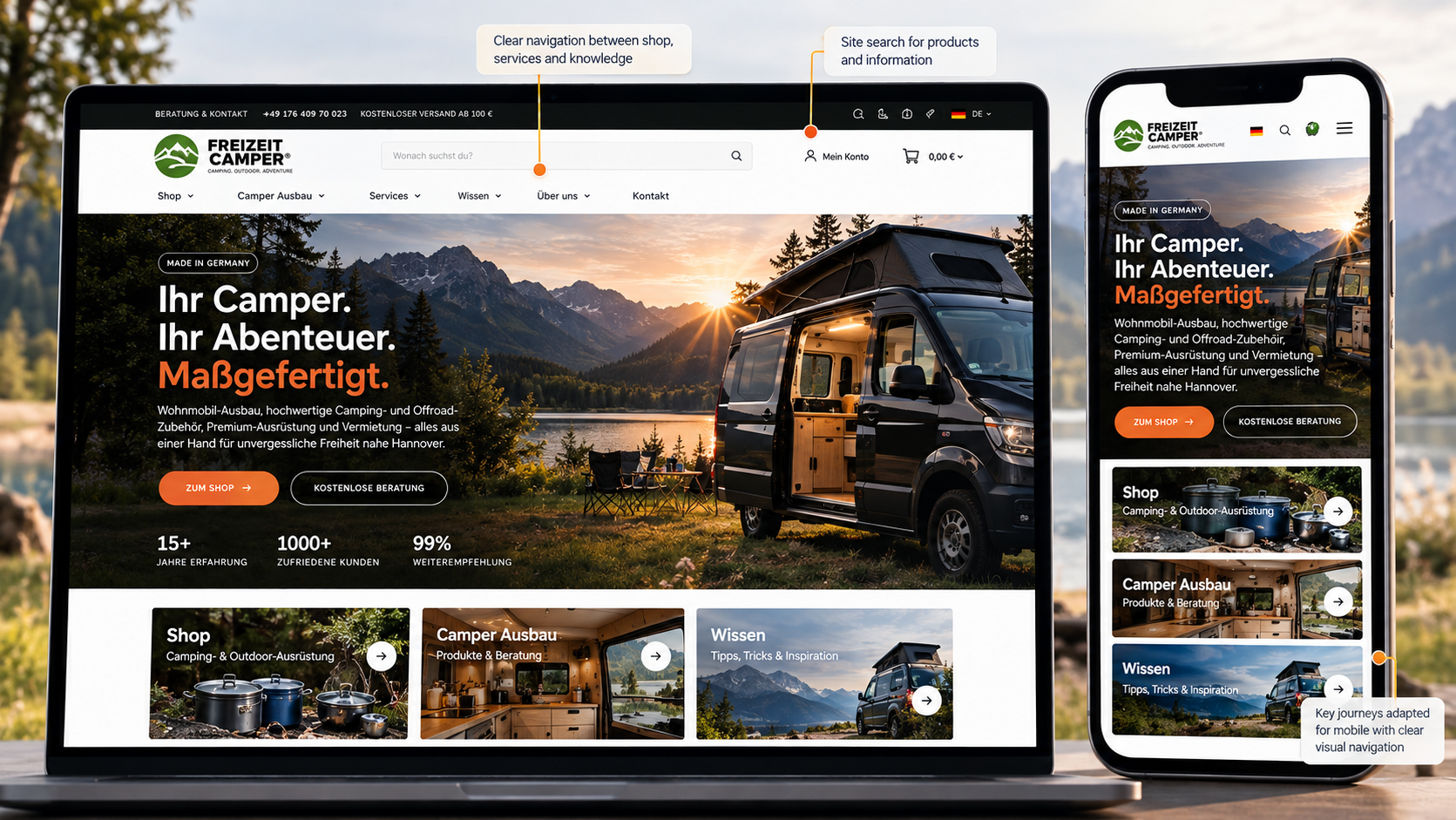 What to notice: responsive design should preserve the important journey while adapting the way information is presented. Navigation may simplify, content order may change and key actions may need different prominence on a smaller screen.
This is why responsive behaviour is considered during the design process rather than treated only as a technical adjustment at the end.
What Good Bespoke Design Should Help You Achieve
A clearer representation of the business
The structure can reflect how your services, products and content actually relate instead of forcing them into a generic navigation model.
More deliberate customer journeys
Pages can be organised around the information users need at different stages, making the next relevant action easier to understand.
A more coherent visual system
Reusable design patterns can create consistency while still allowing different types of content to perform different jobs.
Room for the website to evolve
A well-considered structure can make future additions easier to accommodate, depending on how the website and CMS are implemented.
Design beyond the visual layer
We also consider search-aware information hierarchy, performance-conscious design decisions and accessibility-aware choices around readability, hierarchy and interaction. These considerations support the wider quality of the website without turning the design project into a separate SEO or accessibility service.
Template-Led or Bespoke Website Design?
| Consideration | Template-Led Website | Bespoke Website Design |
|---|---|---|
| Business requirement | Works well when requirements fit an established website pattern. | Useful when the structure or experience needs to respond to more specific requirements. |
| Page structure | Usually based on predefined layouts or components. | Can be planned around the actual content hierarchy and user journey. |
| Brand expression | Can be adapted within the limits of the chosen design system. | Allows greater control over visual hierarchy and interface behaviour. |
| User journeys | Suitable for relatively straightforward journeys. | Better suited where audiences or journeys require more deliberate differentiation. |
| Functionality | Efficient when established functionality already meets the requirement. | Can accommodate more specific interface requirements, with custom development scoped separately where needed. |
| Project scope | Can reduce design and implementation scope. | Usually requires more planning and design decisions because fewer assumptions are predefined. |
A template-led approach is not automatically a compromise. If an established structure already supports the business and its users cleanly, using it can be the more proportionate decision.
How a Bespoke Website Project Moves from Requirement to Launch
1. Define the Requirements
PLD: establish the business, audience, content and functional requirements that affect the website.
Client: provide business context, priorities, existing materials and relevant constraints.
Output: an agreed direction and scope for the next stage.
2. Structure the Experience
PLD: organise information, journeys and page relationships before visual decisions become fixed.
Client: review the proposed structure against real business requirements.
Output: an agreed website structure and UX direction.
3. Approve UX and Visual Direction
PLD: translate the approved hierarchy into interface and visual design, with wireframes where appropriate.
Client: review the direction and provide consolidated feedback.
Output: approved page and interface direction.
4. Build and Review
PLD: where implementation is included, build the agreed interface and configure scope-dependent functionality.
Client: review the working website and provide agreed content or project inputs.
Output: a working implementation ready for final QA.
5. QA and Launch
PLD: review the completed website against the agreed scope and prepare it for launch.
Client: complete final approval and any agreed launch actions.
Output: approved website prepared for publication.
What You Receive
| Deliverable | Status | Purpose |
|---|---|---|
| Information architecture | Core | Defines how the main pages and content areas relate. |
| UX and UI direction | Core | Defines hierarchy, interaction and visual presentation. |
| Responsive design | Core | Defines how the experience adapts across relevant screen sizes. |
| Wireframes | Scope-dependent | Establishes structure and flow before detailed visual design where required. |
| Reusable component system | Scope-dependent | Provides consistent interface patterns across different page types. |
| CMS configuration | Scope-dependent | Supports management of agreed website content. |
| Integrations or custom functionality | Scope-dependent | Supports requirements that go beyond the core website interface. |
| Migration | Scope-dependent | Moves agreed existing content into the new website structure where included. |
| Documentation or training | Scope-dependent | Supports the client’s team in managing the completed website where required. |
How Much Does Bespoke Website Design Cost?
Our bespoke website design services start from £800. The final cost depends on how much planning, design and implementation the project actually requires.
A focused company website and a website combining multiple audiences, content types, ecommerce or specialised functionality should not automatically carry the same scope.
| Factor | How It Affects Scope |
|---|---|
| Information architecture | More services, audiences and content relationships usually require more planning. |
| Number of page types | Distinct page requirements may require additional layouts and components. |
| UX complexity | More specialised journeys or interactions require additional design decisions. |
| Content | The amount, readiness and structure of content can affect planning and implementation. |
| Functionality | Forms, integrations or custom behaviour can extend the technical scope. |
| Ecommerce | Products, categories, checkout and related commercial journeys introduce additional requirements. |
| Migration | Existing pages, products or resources may need mapping and migration. |
| Review and approvals | The number of stakeholders and feedback stages can influence project timing. |
How long does a bespoke website take?
There is no single reliable timeframe for every bespoke website project. Timing depends on the size of the site, number of page types, architecture, UX/UI complexity, functionality, content readiness, migration requirements and the speed of feedback and approvals.
We would define the expected delivery schedule after the requirements and scope are understood.
Bespoke Does Not Have to Mean a Large or Over-Engineered Project
This historical project was delivered with a total project budget of £1,000 and in approximately two weeks. Those figures relate specifically to that project and its scope; they are not current standard pricing or a standard delivery timeframe for bespoke website design.
Client Experience
Related Website Design Services
Website Design
If your requirement is broader and you are still deciding what level of design support you need, our main website design service may be the better starting point.
Website Redesign
If the main requirement is to restructure or improve an existing website rather than create a new website direction, the dedicated redesign service is more specific.
B2B Website Design
For businesses where the website needs to support longer B2B decision journeys and complex service information, see the dedicated B2B website design service.
Small Business Website Design
For a more focused company website with relatively straightforward requirements, small business website design may provide a more proportionate scope.
WordPress Web Design
If WordPress is already the chosen platform and the primary requirement is the website’s design and user experience, explore our WordPress Web Design service.
Custom WordPress Development
Where the requirement extends beyond design into specialised WordPress functionality, custom development can be scoped separately.
Bespoke Website Design FAQs
What is bespoke website design?
Bespoke website design means making the website’s structure, UX and interface decisions around the specific requirements of the business and its users rather than relying entirely on a predefined template. It does not mean that every element has to be custom-built from scratch.
What is the difference between bespoke and template website design?
A template-led website starts with an established structure and adapts it to the business. Bespoke design allows the structure and interface to be planned more specifically around the content, audiences and journeys required. Either can be appropriate depending on the project.
Does every business need a bespoke website?
No. If a standard structure already supports the business, its content and its users effectively, there may be little commercial value in adding unnecessary customisation.
How much does bespoke website design cost?
Our bespoke website design services start from £800. The final cost depends on architecture, page types, UX/UI requirements, functionality, content, ecommerce, integrations and migration requirements.
How long does a bespoke website take?
Timing depends on the size and complexity of the project, content readiness, functionality, migration and the review and approval process. We define the expected schedule once the requirements and scope are understood.
Can you redesign an existing website?
Yes. Where the main requirement is improving an existing website rather than planning a new one, our dedicated Website Redesign service may be more relevant.
Will we be able to manage the website ourselves?
Where content management is included in the project, the website can be structured so agreed content can be managed through the selected CMS. The exact editing capabilities depend on the implementation and project scope.
Does bespoke website design automatically improve SEO?
No. Bespoke design does not automatically produce better search rankings. It can, however, give greater control over information architecture, page hierarchy, internal relationships and content presentation, which can support a wider SEO strategy when implemented appropriately.