Tell us a little about what you’re looking for, and our team will be in touch to discuss how we can help.
Professional Video Production Planning Services in the UK
A filming date is only useful when the people, locations, equipment and decisions behind it are ready. Prime Lion Digital offers video production planning for businesses, marketing teams and production projects that need a clearer route from creative brief to a workable shoot.
We help identify unresolved requirements, organise filming dependencies and establish what needs to happen before production begins. Planning services start from £300, with the final scope and fee agreed around your project.
Request a Production Planning Quote | Explore Pre-Production Services
Why Video Production Planning Matters Before Filming
A creative idea can be approved while the practical requirements for filming remain uncertain. A marketing team may know the message it wants to communicate but not yet have confirmed who needs to appear, where individual scenes can be recorded or which decisions affect the filming schedule.
Video production planning brings those requirements together before resources are committed. The objective is not to produce more paperwork. It is to identify what must be decided, what can remain flexible and which unresolved dependencies could affect the shoot.
Common Problems That Make Video Shoots Difficult to Prepare
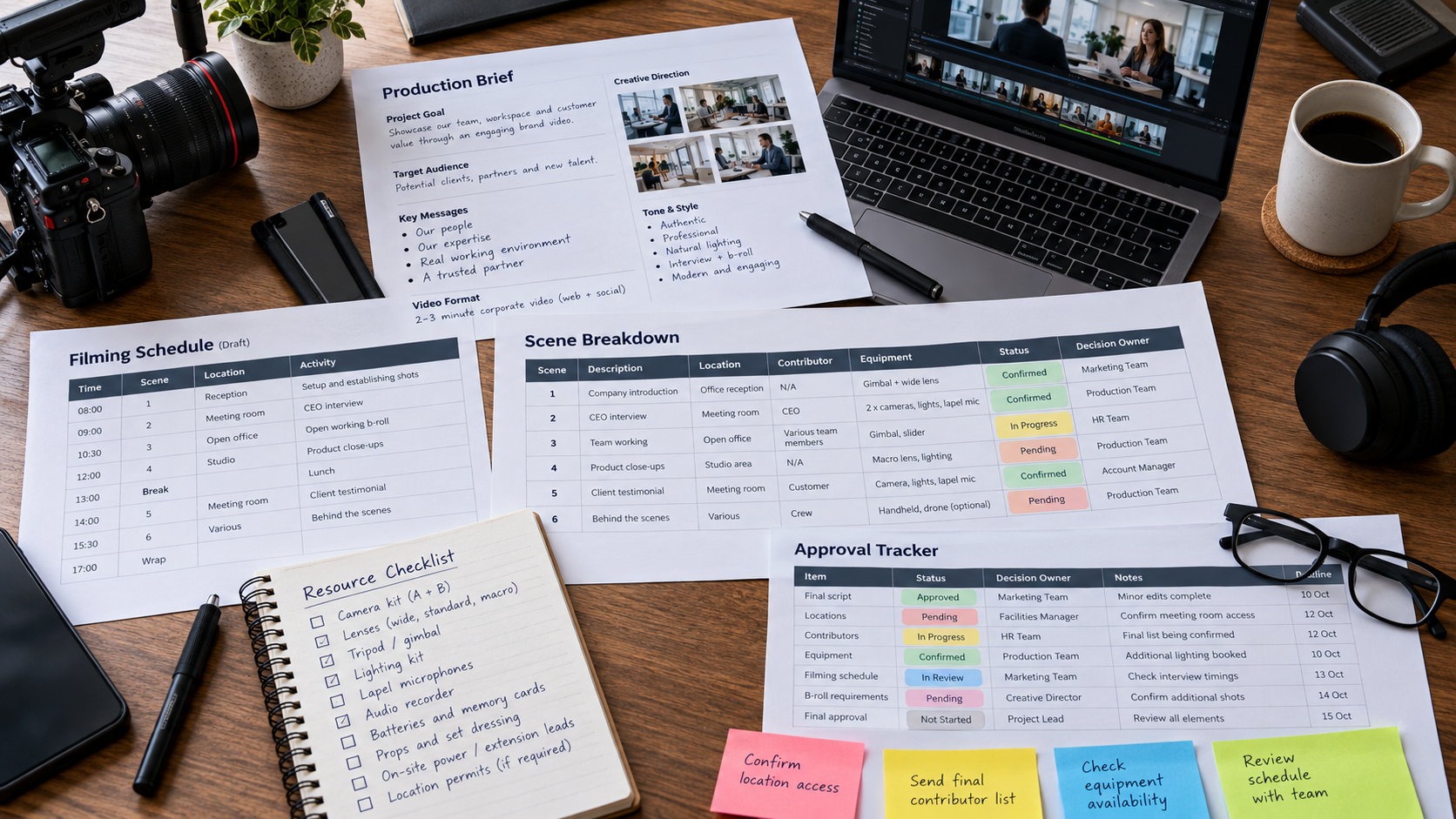
1. A brief that does not define the production requirements
The intended message may be clear, but the number of scenes, contributors, locations or visual requirements may not be. Without that detail, it is difficult to assess the work needed for filming.
2. Scheduling decisions made before dependencies are checked
A preferred filming date does not establish whether locations, participants and specialist resources can be available together. The order of scenes also matters: a schedule that ignores setup changes or access restrictions may need revision.
3. Unclear resource requirements
Equipment, crew roles, props, lighting or specialist access may depend on the actual scenes. Resource planning should follow the production requirements rather than rely on assumptions about what a typical shoot needs.
4. Decisions without a clear owner
Production preparation can stall when nobody is responsible for approving locations, contributors, scripts or changes. Identifying decision owners helps separate work that is genuinely ready from work awaiting confirmation.
5. Budget assumptions that have not been tested against the brief
An initial budget may not account for multiple locations, additional contributors, specialist equipment or complex setup requirements. Production planning can make these assumptions visible before a detailed filming quotation is finalised.
Signs Your Video Shoot May Need More Planning
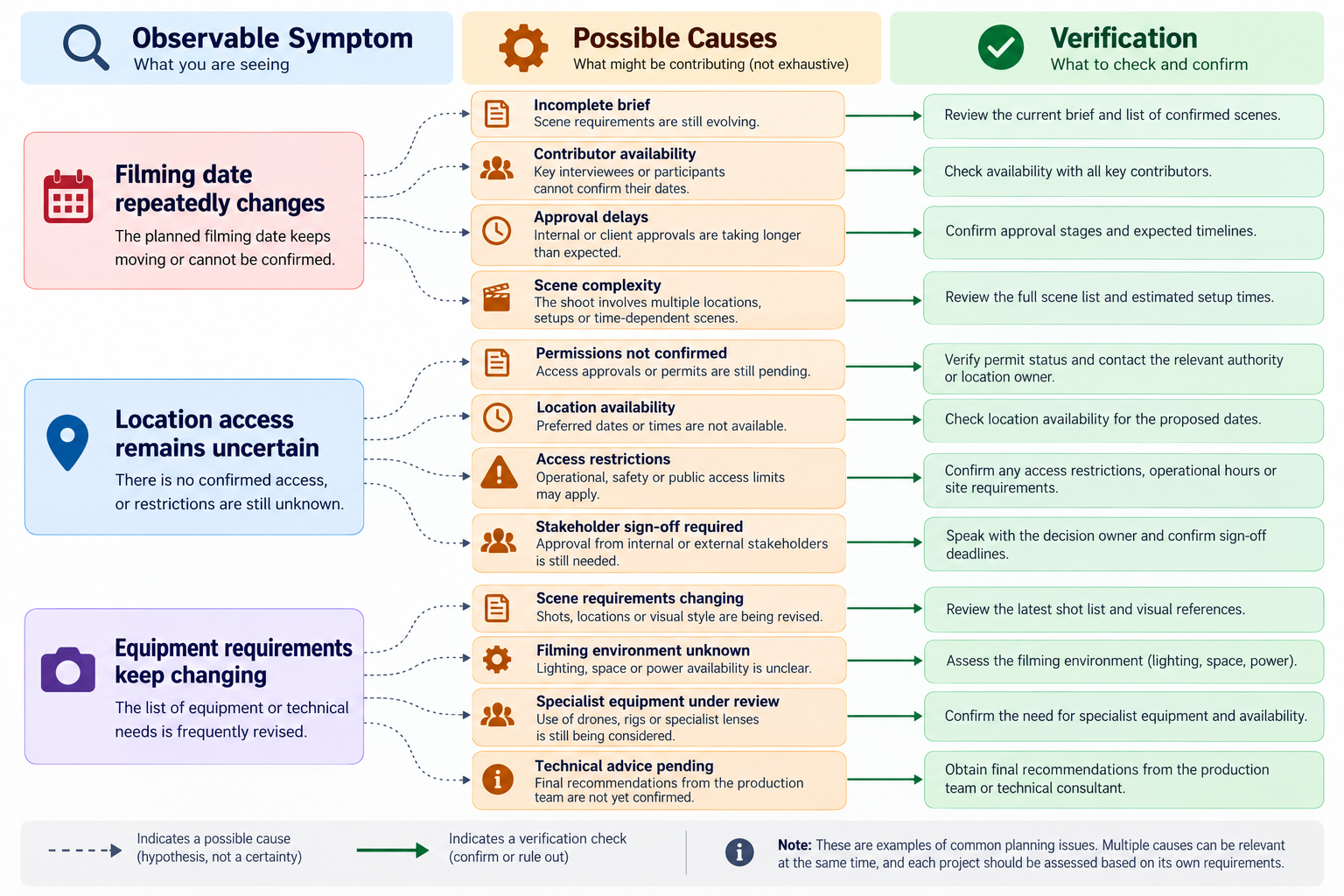
These are observable warning signs, not proof of a particular underlying cause. The appropriate response depends on what the project documents and stakeholders actually confirm.
| What you are seeing | What it may indicate | What to check |
|---|---|---|
| A date has been selected, but there is no detailed filming schedule. | Scene requirements or resource availability may not have been mapped. | Scene list, location access, contributors and setup requirements. |
| Different team members are working from different document versions. | Document ownership or approval controls may be unclear. | Current approved version and responsible decision-maker. |
| Location access has not been confirmed. | Availability, permissions or practical constraints may still be unresolved. | Access times, restrictions and location contact. |
| Shot requirements keep changing. | The creative brief may still be evolving, although changes can also be legitimate. | Approved objectives, scene priorities and change decisions. |
| Equipment requirements are uncertain. | The scene breakdown may not contain enough technical detail. | Visual requirements, filming conditions and specialist needs. |
| Approvals are repeatedly delayed. | Responsibilities or review deadlines may not be agreed. | Decision owners, approval stages and outstanding questions. |
Production Readiness: What Is Ready, Pending or Blocked?
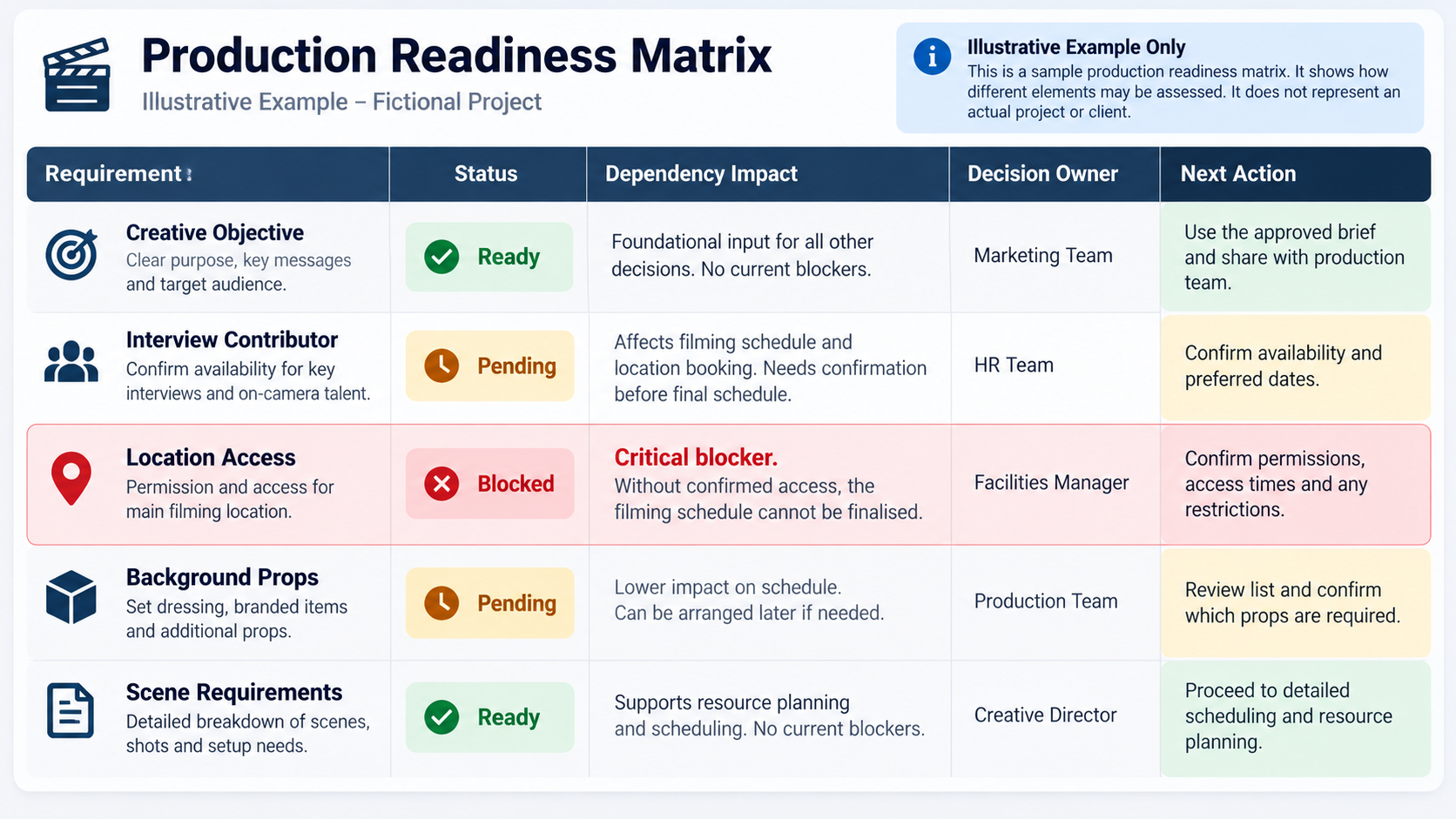
Not every unresolved item should hold up the entire project. The important distinction is whether the missing decision affects another activity that cannot be planned reliably without it.
| Requirement | Illustrative Status | Why It Matters | Next Action |
|---|---|---|---|
| Creative objective | Ready | Establishes the purpose of the video. | Use the approved brief. |
| Essential interview contributor | Pending | Availability affects the interview schedule. | Confirm the contributor and preferred window. |
| Filming location access | Blocked | Access restrictions may affect scene feasibility. | Confirm permissions before locking the schedule. |
| Non-essential background props | Pending | May be resolved later without affecting critical scenes. | Assign an owner and review date. |
| Scene requirements | Ready | Support resource and setup assessment. | Proceed to detailed scheduling. |
Illustrative example only. Statuses are fictional and do not represent an actual Prime Lion Digital project.
What Our Video Production Planning Services Can Cover
Prime Lion Digital’s production planning service can be scoped around the information already available and the decisions still needed. The following activities describe potential areas of support, not a fixed package automatically included at the starting price.
| Planning Activity | What It Involves | Practical Purpose |
|---|---|---|
| Production brief review | Reviewing objectives, intended audience, creative requirements and available project information. | Identify gaps and assumptions that affect preparation. |
| Scene and shot requirements | Breaking the intended content into scenes, contributors, locations and relevant resources. | Establish what needs to be filmed and prepared. |
| Video production scheduling | Developing a draft sequence based on access, availability and setup dependencies. | Support a workable filming plan. |
| Filming logistics planning | Assessing location access, movement, practical restrictions and preparation requirements. | Make logistical constraints visible. |
| Resource planning | Identifying crew, equipment, props and specialist requirements where relevant. | Inform production preparation and quotation decisions. |
| Budget assumptions | Documenting factors that may influence production cost. | Help distinguish estimates from confirmed requirements. |
| Approval and action tracking | Recording outstanding decisions, owners and next actions. | Make responsibilities and readiness easier to assess. |
Creative development services such as video scriptwriting and storyboarding may support planning, but they should be quoted separately where they are outside the agreed scope.
When Production Planning Is Particularly Useful
Corporate filming with several contributors
Interviews, workplace footage and staff availability can create competing scheduling requirements. A production plan can help identify which contributors, rooms and approvals need to align.
Promotional or commercial video shoots
Campaign footage may involve product setups, different scenes, specialist lighting or location changes. Planning helps assess how those creative requirements translate into practical preparation.
More complex narrative or cinematic productions
Projects involving multiple scenes, performers or technical setups can benefit from a structured breakdown of filming requirements and dependencies. The level of planning should reflect the production rather than follow a standard document count.
Our Video Production Planning Process
The planning method should reflect the project, but the professional reasoning follows a consistent principle: decisions with the greatest effect on filming readiness should be examined before less consequential details.
1. Establish the requirements
Review the available brief, creative material and production objectives. Identify what is confirmed, what is assumed and what remains unknown. The initial output is a clearer statement of the scenes and production requirements to investigate.
2. Break down scenes and resources
Translate the creative requirements into practical needs: contributors, locations, equipment, props, specialist support and relevant setup considerations. This makes it possible to examine the production as a set of connected activities rather than one filming date.
3. Map critical dependencies
Determine which requirements affect others. For example, a location restriction may change when an interview can be filmed, which equipment can be used and whether other scenes can share the same setup. Critical dependencies should be resolved or clearly flagged before a schedule is treated as reliable.
4. Test feasibility and develop the schedule
Assess availability, access constraints, scene order and likely setup changes. Prepare a draft schedule based on the information available, while identifying assumptions that still require confirmation. The draft should not be presented as a final booking schedule.
5. Assign decisions and review readiness
Record outstanding questions, responsible parties and approval requirements. Where a decision remains open, assess whether it blocks the next planning stage or can be addressed later.
6. Prepare the agreed planning handover
Organise the relevant documents and decision records so that the people responsible for production can see the intended sequence, required resources and unresolved items. The final handover content depends on the agreed service scope.
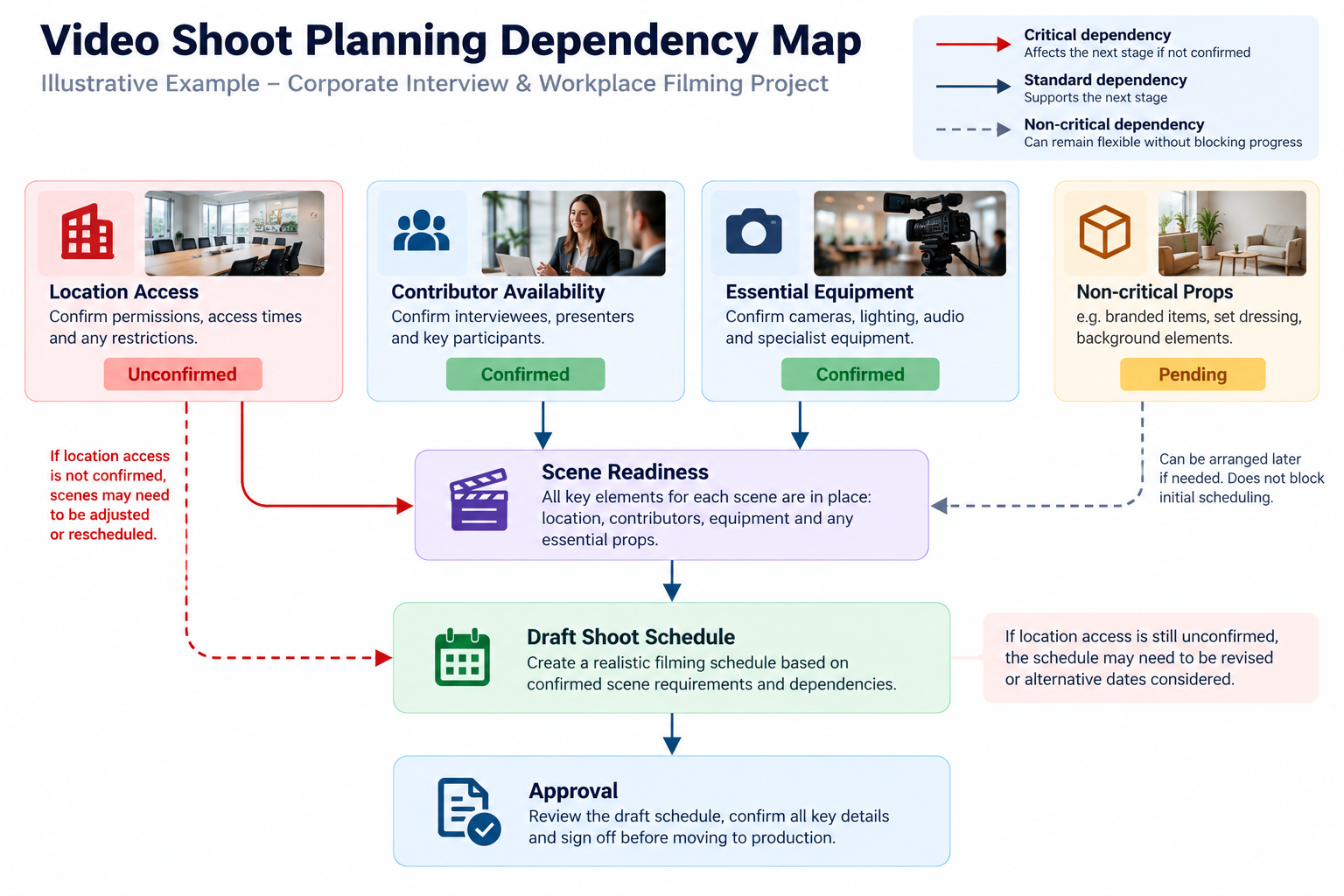
Expert Insight: Confirm the Decisions That Affect Everything Else
The most important production planning decision is not always the filming date. It is often the requirement that determines whether several other decisions can be made confidently.
Consider an interview scheduled inside an operational workplace. If access is restricted to certain hours, that constraint may determine contributor availability, lighting requirements, crew arrival times and the order of supporting footage. Selecting a date before checking access can create a schedule that looks complete but rests on an unverified assumption.
A useful approach is to distinguish critical dependencies from flexible preferences. Essential contributors, location permissions and specialist resources may need early confirmation. Minor visual preferences or non-essential props can sometimes remain open for longer, provided someone owns the decision and the deadline is clear.
Production planning is therefore as much about decision priority as it is about organising tasks. A strong plan shows not only what should happen, but which assumptions must be validated before the next commitment is made.
What Can You Receive from a Production Planning Service?
The deliverables depend on the scope agreed for your project. The examples below show the types of planning outputs that may be appropriate; they are not all guaranteed within the £300 starting fee.
| Potential Deliverable | Typical Contents | Why It Is Useful |
|---|---|---|
| Planning brief | Objectives, production requirements, assumptions and outstanding questions. | Establishes a shared working reference. |
| Scene breakdown | Scenes, contributors, locations, visual needs and resource considerations. | Connects creative requirements to preparation. |
| Draft shoot schedule | Proposed sequence, scene groups, setup considerations and dependencies. | Supports practical scheduling discussions. |
| Resource checklist | Potential crew, equipment, props and specialist requirements. | Highlights items needing confirmation. |
| Logistics notes | Location access, restrictions and practical arrangements to investigate. | Reduces uncertainty about the filming environment. |
| Approval and action register | Open decisions, responsible people, statuses and next actions. | Shows who needs to do what. |
| Budget assumptions | Cost-sensitive requirements and areas needing a production quote. | Supports clearer financial discussions. |
| Readiness summary | Confirmed requirements, pending items and critical blockers. | Helps assess whether preparation can progress. |
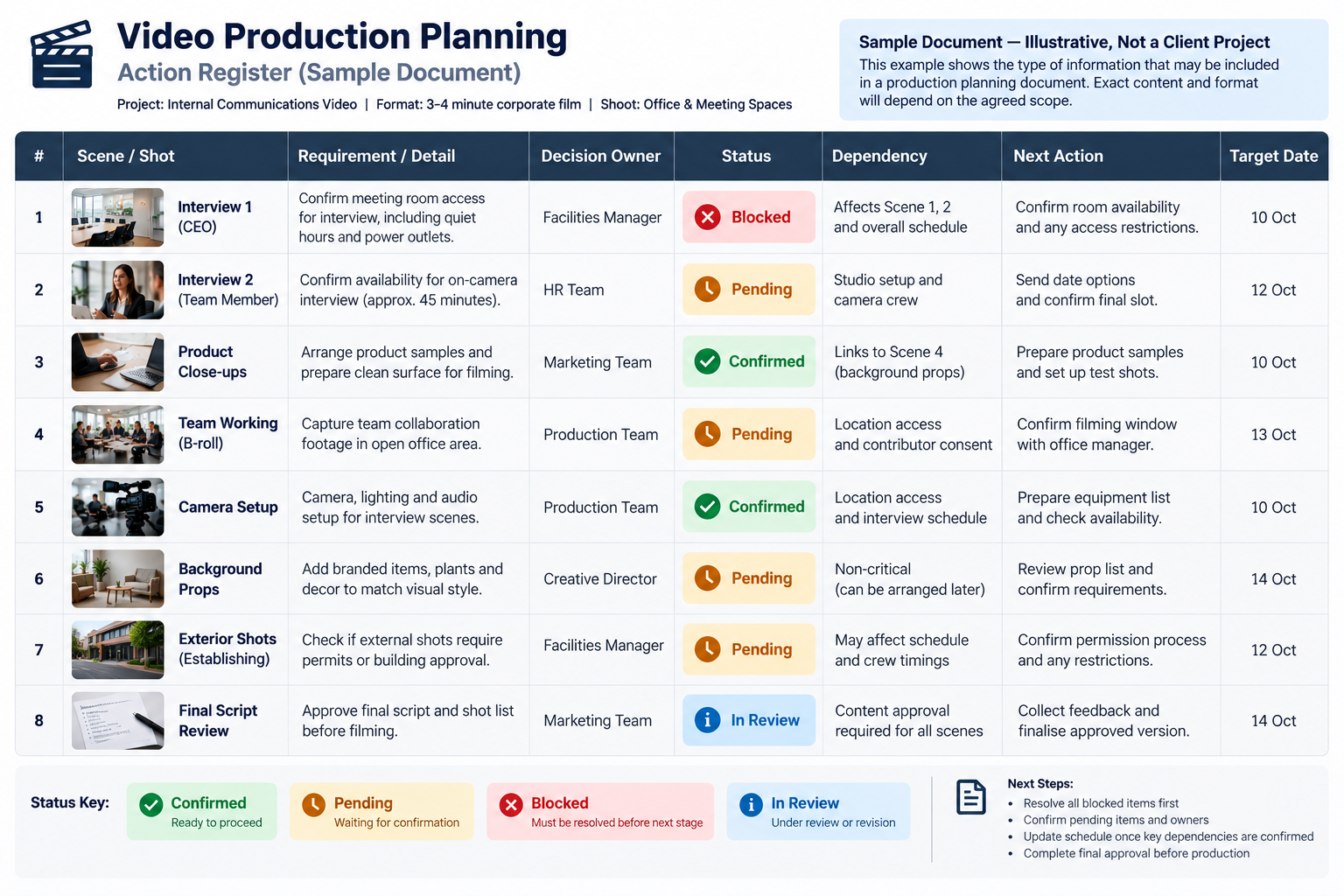
What Better Production Planning Can Help Achieve
The immediate output of planning is clearer information and a more organised set of decisions. Potential practical benefits include fewer unresolved questions when arranging filming, better visibility of resource requirements and a clearer basis for coordinating contributors.
For example, a project that begins with an informal list of scenes may progress to a structured breakdown, a draft schedule and an action register. That is a conceptual illustration of improved planning clarity, not a claim of measured cost savings or a completed Prime Lion Digital client result.
Have a Brief but Still Have Unanswered Questions?
You do not need every production detail finalised before asking for planning support. Share the brief you have, the intended filming date if known and the decisions that are proving difficult. That information can help define an appropriate scope of work.
Discuss Your Shoot Requirements
Production Planning vs Video Filming
These activities are related but serve different purposes. A production plan can support a filming project without including the filming service itself.
| Production Planning | Video Filming |
|---|---|
| Reviews requirements and dependencies. | Records the required footage. |
| Develops proposed schedules and resource needs. | Uses agreed production arrangements on location. |
| Identifies unresolved permissions and decisions. | Operates within the confirmed filming conditions. |
| Produces planning documentation as agreed. | Produces recorded material within the filming scope. |
For projects requiring the production stage, explore Corporate Filming. Planning and filming should be quoted according to the actual work required.
How Much Does Video Production Planning Cost in the UK?
Video production planning services from £300.
The final fee depends on the requirements, complexity and planning outputs agreed for your project. A straightforward shoot with a defined brief may require less planning work than a production involving multiple locations, contributors and technical setups.
What affects production planning cost?
- Number and complexity of scenes: More setups may require a more detailed breakdown.
- Locations: Multiple sites or restricted access can increase logistical assessment.
- Contributors: Interviewees, presenters and other participants introduce availability dependencies.
- Technical requirements: Specialist filming conditions or equipment may need additional planning.
- Scheduling complexity: Limited access windows and setup changes can affect the work involved.
- Documentation: The level of detail required for schedules, registers and handover materials varies.
- Approval requirements: Multiple stakeholders or revision rounds may affect the agreed scope.
The £300 figure is a starting price, not a promise that every activity or deliverable described on this page is included. A quotation should confirm the actual scope and fee before work begins.
How Long Does Production Planning Take?
There is no single reliable turnaround for every video production planning project. Timing depends on how complete the brief is, the number of scenes and locations, the availability of relevant information and how quickly decisions can be approved.
Projects with confirmed requirements may progress more directly. Where essential access, contributors or technical requirements remain unresolved, those dependencies can affect when the plan is ready for approval.
Related Video Production Services
- Pre-Production Services — the wider preparation stage covering creative and practical development.
- Video Scriptwriting — developing the narrative and spoken content before filming requirements are finalised.
- Video Storyboarding — planning the visual sequence, framing and intended shots.
- Corporate Filming — recording footage once production arrangements have been agreed.
- Video Production — exploring the wider production service range.
Video Production Planning FAQs
What is video production planning?
Video production planning is the practical preparation of a shoot. It involves identifying scene requirements, resources, scheduling dependencies, logistical constraints and decisions needed before filming.
What is included in your production planning service?
The scope may cover brief assessment, scene breakdowns, video shoot planning, scheduling, resource requirements, logistics and approval tracking. The exact activities and deliverables are confirmed in your quotation.
How much does video production planning cost?
Prime Lion Digital’s production planning services start from £300. The final price depends on project complexity and the work agreed.
How long does the production planning process take?
It depends on the brief, number of scenes, locations, contributors and outstanding decisions. An appropriate timeframe can be discussed once the project requirements have been reviewed.
Do I need a finished script before production planning?
Not necessarily. An initial brief may be enough to begin identifying production requirements. However, an unfinished script can leave scene and resource assumptions unresolved. Scriptwriting can be scoped separately if needed.
Can Prime Lion Digital help with filming logistics?
Logistical assessment can form part of the agreed planning scope. Actual bookings, permissions, equipment hire and on-site arrangements should not be assumed to be included unless specifically confirmed in the quotation.
Will I receive a production planning template or schedule?
Planning documents can be prepared where included in the agreed scope. The format and level of detail depend on the project; a downloadable template or specific document set is not automatically included.
What information should I provide for a quote?
Share your brief, intended video format, preferred filming date, locations, contributors and any known constraints. If some details are still undecided, identify them so they can be considered when defining the planning work.
Plan Your Next Video Shoot with Clearer Requirements
If you have a production brief but still need to establish the filming requirements, schedule or critical decisions, Prime Lion Digital can discuss a suitable video production planning scope.
Send your existing materials and explain what remains uncertain. We can then assess the information available and discuss the planning work required.
Video production planning from £300.