Tell us a little about what you’re looking for, and our team will be in touch to discuss how we can help.
Colour Grading Services in UK
Give your footage a considered, consistent visual finish with professional colour grading from Prime Lion Digital. We refine colour, balance shots and develop a visual look that supports your story, product or brand.
Our video colour grading services are available to businesses, marketing teams, production companies and independent filmmakers across the UK. We work with supplied footage and edited sequences, with projects starting from £250.
Professional colour grading from £250. Send us your footage, project requirements and visual references for a tailored quotation.
Get a Colour Grading Quote — Tell us about your project and the finish you want to achieve.
Professional Video Colour Grading Services in the UK
Colour grading shapes how a finished video feels. A carefully developed look can make an interview appear natural and welcoming, give a commercial a more distinctive atmosphere or help different scenes feel like parts of the same production.
Prime Lion Digital provides colour grading for video projects that need more than a basic filter or automatic adjustment. Our work can include balancing exposure, refining white balance, matching shots, controlling saturation, protecting natural skin tones and developing an agreed creative look.
For businesses, this means presenting people, locations and products with greater visual consistency. For filmmakers, it means supporting the intended mood without losing important detail in the image.
Our colour grading services UK clients can commission remotely, making it possible to work with footage recorded in different locations without attending an editing studio.
Colour Grading Before and After
The clearest way to judge a colour grade is to compare the same frame before and after treatment. A strong result does not always mean a dramatic change. Sometimes the improvement is a more natural skin tone, better balance between two cameras or more controlled highlights.

When reviewing colour grading examples, look beyond the overall mood. Check whether faces remain believable, colours are consistent between shots, shadows retain useful detail and the result suits the subject.
A dramatic cinematic treatment might work beautifully for a short film but feel inappropriate for a medical interview or a product demonstration. The right grade is the one that serves the footage and its intended audience.
Colour Correction vs Colour Grading: What’s the Difference?
Colour correction and colour grading are closely related, but they solve different problems. Colour correction establishes a technically consistent image. Creative grading builds on that foundation to develop a particular visual style.
| Colour correction | Colour grading |
|---|---|
| Adjusts exposure and white balance | Develops the desired visual atmosphere |
| Balances contrast and colour casts | Shapes contrast for creative effect |
| Matches footage from different cameras | Creates a consistent look across scenes |
| Helps skin tones and objects appear natural | Uses colour to influence mood and emphasis |
| Prepares footage for a coherent finish | Gives the finished video its intended character |
Many projects benefit from both stages. Our colour correction and grading services can be scoped together, depending on the condition of your footage and the final result you need.

Cinematic Colour Grading & Creative Looks
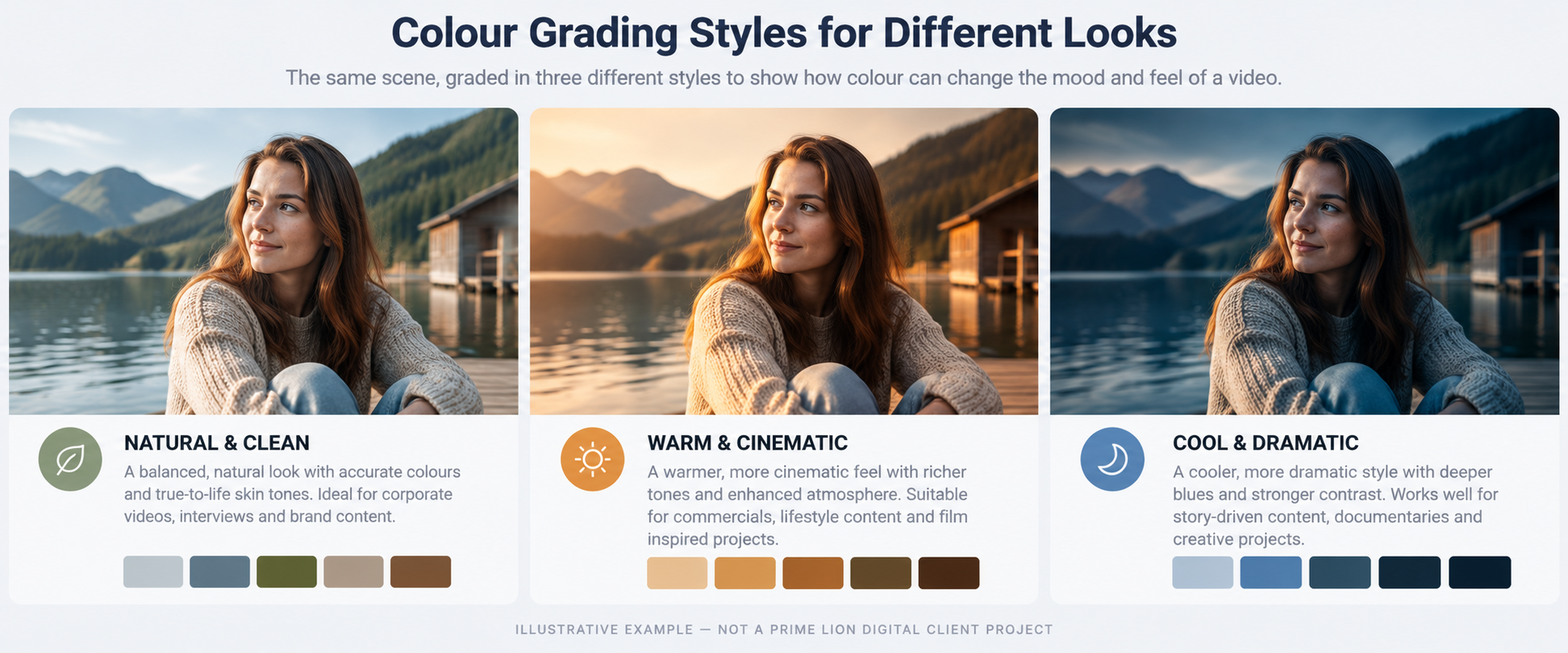
Cinematic colour grading is about visual intention, not simply making every image darker or adding a teal-and-orange filter. The appropriate look depends on lighting, production design, camera footage, subject matter and where the video will be viewed.
Natural & Brand-Consistent Colour
Corporate films, interviews and customer-facing business videos often benefit from restrained grading. The priority is to make people and locations look credible while keeping the overall image consistent with the brand.
Natural skin tones, balanced interiors and controlled contrast are often more valuable than a heavily stylised finish.
Cinematic & Film-Inspired Looks
Cinematic video colour grading can support a warm, nostalgic atmosphere, a cooler dramatic scene or a softer documentary aesthetic. Film colour grading also needs continuity: the look should remain coherent as lighting, locations and camera angles change.
Creative references are useful, but the achievable result depends on the original footage. A grade cannot recover detail that was never recorded or reproduce lighting that was not present during filming.
Commercial & Product Colour Grading
Commercial video colour grading has to balance visual appeal with accurate presentation. Product colours may need to remain recognisable, while backgrounds, highlights and contrast can be adjusted to direct attention.
For product-led campaigns, colour decisions should be agreed with reference to the brand and the intended final display rather than judged only by how striking a single frame looks.
What Our Colour Grading Services Include
The exact scope is agreed after reviewing your footage. A typical professional colour grading project may involve several of the following treatments.
Exposure, White Balance & Colour Refinement
We review the overall image and refine exposure, contrast, colour balance and saturation where needed. This helps establish a reliable foundation before creative decisions are applied.
Shot Matching & Visual Continuity
Footage captured at different times or on different cameras may not match naturally. Shot matching aims to reduce distracting differences so that a sequence feels coherent.
Skin Tones & Selective Adjustments
Where the material supports it, selective adjustments can help maintain believable skin tones, control particular colour areas or direct attention towards the subject without unnecessarily changing the rest of the frame.
Creative Look Development
Reference images, brand guidance and the intended audience inform the creative direction. Rather than relying on a generic preset, the aim is to develop a look appropriate to the actual footage.
Colour Grading Post-Production & Finishing
Colour work is coordinated with the agreed edit and delivery requirements. A project may require a standard SDR finish, alternative versions or additional technical preparation, depending on the brief.
Complex restoration, visual effects, extensive re-editing, HDR mastering and specialist deliverables are separate scope considerations rather than automatically included services.
Colour Grading for Corporate, Commercial & Film Projects
Different productions call for different priorities. We assess the footage in the context of how it will be used.
| Project | Typical priority | What to consider |
|---|---|---|
| Corporate video colour grading | Natural people, consistent locations and brand presentation | Interviews, mixed lighting and multiple cameras |
| Commercials and advertising | Visual identity, product emphasis and controlled contrast | Brand colours and campaign references |
| Film and documentary | Atmosphere, continuity and storytelling | Scene transitions and creative intent |
| Social media video | Consistent branded appearance across shorter edits | Mobile viewing and multiple output formats |
| Interviews and testimonials | Believable skin tones and balanced camera angles | Changing light and camera matching |
Colour Grading Examples & Samples
When comparing a colour grading studio or colour grading company, ask to see work relevant to your production. A dramatic music video does not necessarily demonstrate the same skills required for an interview, product commercial or documentary.
The most useful colour grading samples show how a colourist handles the actual subject: people, products, changing light, multiple camera angles and scene continuity.
How We Approach Colour Grading
A good grade begins with understanding what the footage can realistically support. Creative references help establish direction, but they are not instructions that can be applied identically to every camera file.
Expert Insight: Why a LUT Is Not a Finished Grade
A common request is to make a video look like a particular film or advert. A reference can be valuable, but two productions rarely start with the same lighting, camera settings, lenses or colour information. Applying the same LUT to both may produce very different results.
A LUT can be useful within a controlled colour workflow, but it does not automatically correct exposure, match cameras or protect skin tones. Log footage also needs appropriate interpretation before its final contrast and colour can be judged properly.
Our recommended approach is to assess representative shots first, agree the creative direction and establish a consistent base before extending the treatment across the edit. That makes feedback more meaningful and reduces the risk of approving an attractive individual frame that does not work across the full video.
For the client, the practical lesson is simple: send visual references, but also provide the best available source files and explain what you like about each example. Warmth, contrast, natural skin tones and a particular atmosphere are more useful instructions than asking for a generic cinematic filter.
Have Footage Ready for Colour Grading? Share a representative clip, the intended final use and any visual references so we can assess the project.
Colour Grading Workflow: From Footage to Final Look
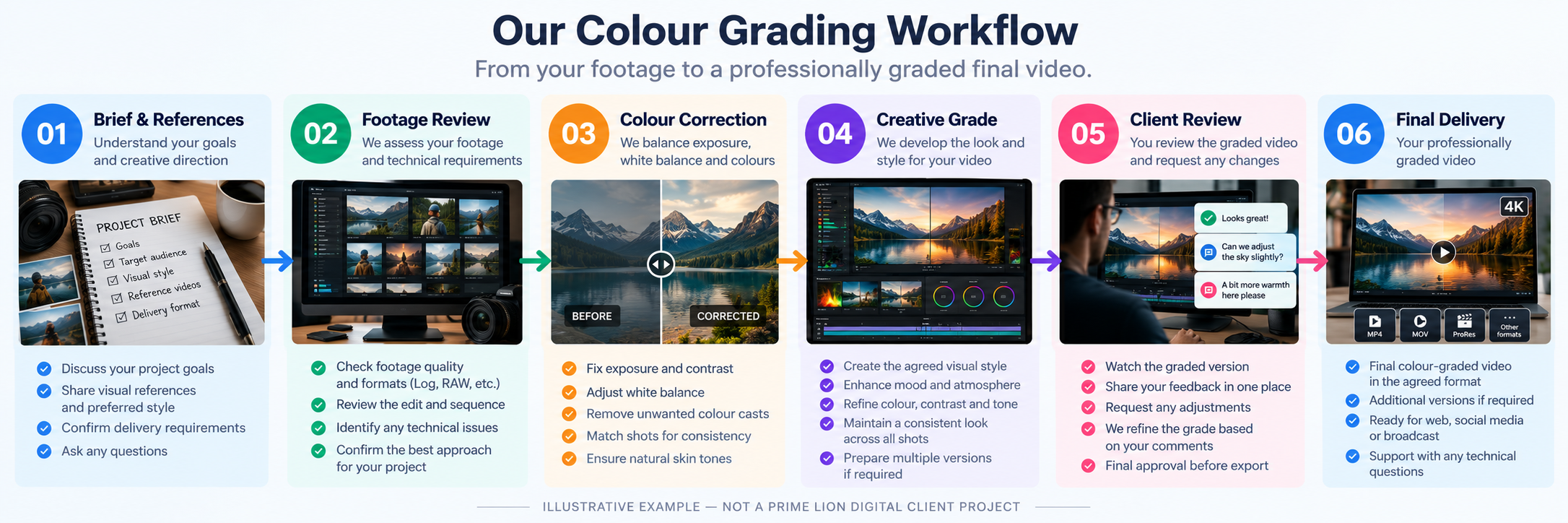
- Brief and visual references. We establish the intended audience, mood, brand requirements and delivery format. You provide examples of the look you want to achieve.
- Footage and project review. We assess the source material, existing edit, camera formats and any limitations that may affect the grade.
- Technical colour correction. Exposure, white balance and shot consistency are addressed as required by the footage.
- Creative colour grading. The agreed visual direction is developed and applied across the relevant shots.
- Review and feedback. You review the graded material and provide consolidated comments within the agreed revision scope.
- Final finishing and delivery. We prepare the agreed graded output for its intended use.
What You Receive
The primary deliverable is a finished colour-graded video file in the format agreed for your project. The quotation should identify the material being graded, the intended output and any additional requirements.
| Deliverable | How it is handled |
|---|---|
| Colour-graded final video | Core project output in the agreed format |
| Shot matching and creative treatment | Work performed within the agreed grading scope |
| Alternative aspect ratios or output versions | Available where included in the quotation |
| Graded stills or look references | Optional, subject to the brief |
| Project files, LUTs or specialist masters | Not assumed to be included; specify in advance |
If you need the grade returned to another editor or post-production team rather than supplied as a finished video, explain that before work begins. The required handover can affect file preparation and pricing.
What Footage Do We Need for Colour Grading?
High-quality source files generally provide more flexibility than heavily compressed copies. We can assess footage from different cameras, but the amount of recoverable colour and highlight detail depends on what was recorded.
For an accurate quotation, please prepare:
- The edited video or a representative sample of the footage.
- Original or highest-quality available source files, where possible.
- Camera details and recording format, if known.
- Information about Log, RAW or other picture profiles, where relevant.
- Reference images or videos showing your preferred colour grading styles.
- The intended platform, resolution, aspect ratio and delivery requirements.
- Any brand colour guidelines or product colour requirements.
- Confirmation of whether the edit is picture-locked or may still change.
Colour grading RAW footage or Log material can provide useful adjustment flexibility when the files contain the necessary information. However, not every file described as raw is a camera RAW format, and not all footage has the same latitude for adjustment.
Understanding Rec.709 Colour Grading
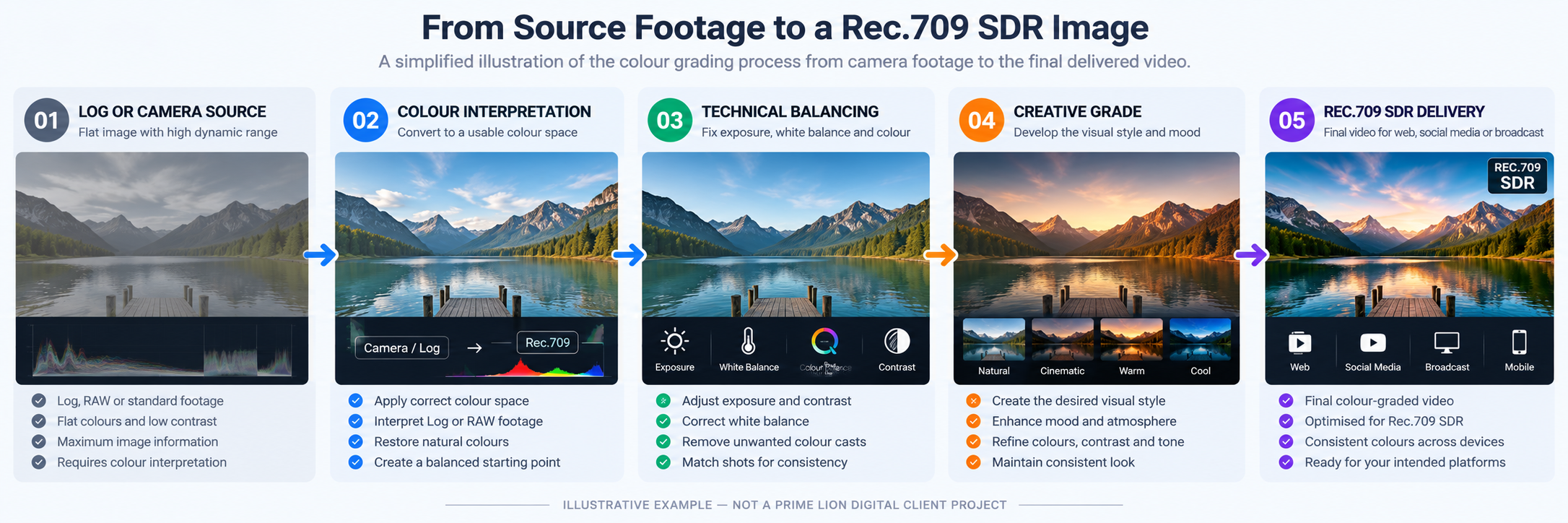
Rec.709 is a widely used standard associated with conventional SDR video delivery. A colour grading Rec.709 workflow aims to produce an appropriate image for the agreed SDR output, with colour management and monitoring considered throughout the process.
Log footage is not necessarily ready for normal SDR viewing without suitable colour-space conversion or other colour management. The required workflow depends on the camera source and final delivery specification.
Colour Grading Price UK
Our video colour grading cost starts from £250 for a relatively straightforward short project with a defined edit and manageable source footage.
This is a starting price, not a fixed charge for every video. Longer productions, mixed camera formats, extensive shot matching and specialist finishing requirements may need a more detailed quotation.
What Affects the Price?
- Footage length and number of shots: A short video with many different camera angles may require more work than a longer, consistently filmed sequence.
- Source quality: Underexposure, mixed lighting, compressed footage or inconsistent white balance can increase the work required.
- Camera formats: Matching footage from several cameras can add complexity.
- Creative direction: A restrained natural grade may require a different level of work from a heavily stylised treatment.
- Selective adjustments: Detailed work on particular subjects or areas of the frame can take additional time.
- Deliverables: Multiple versions, specialist formats and additional handover requirements can affect scope.
- Revisions: The number and extent of agreed review rounds influence the final quotation.
To compare a colour grading price UK providers quote, check what is actually included. A day rate, hourly rate and fixed-project quote may cover very different deliverables.
We recommend sending the edited video or sample footage before requesting a final price. This makes it easier to distinguish a straightforward grade from a project that needs significant correction or technical preparation.
Colour Grading Studio & Remote Services Across the UK
Prime Lion Digital supports colour grading projects for clients across the United Kingdom, including London and other UK locations. Much of the collaboration can take place remotely through file transfer, reference sharing and online feedback.
If you are searching for colour grading London services or a colour grading studio near me, consider whether your project actually requires an attended grading session. For many business videos, a remote workflow can be practical when the source files, review process and delivery requirements are agreed in advance.
Businesses looking to hire a colourist in the UK should assess relevant work, communication, technical handover and project scope rather than location alone.
In-person attendance, specialist studio facilities and particular monitoring arrangements should be confirmed separately if they are essential to your production.
More Colour Grading Examples
Additional examples can help you assess consistency across different scenes, subjects and lighting conditions. Ideally, a portfolio should include complete sequences as well as selected still frames.
Colour Grading FAQs
What is colour grading?
Colour grading is the process of adjusting the colour, contrast and visual character of video footage to create a desired appearance. It can help establish mood, improve visual continuity and support the intended story or brand presentation.
What is colour grading in video editing?
In video editing, colour grading is generally part of post-production. It is usually performed after the main edit has been established, although colour decisions may be considered earlier. The aim is to give the finished sequence a consistent and intentional look.
What does colour grading do to a video?
It can make shots feel more consistent, refine skin tones, influence the atmosphere and guide visual attention. The extent of the change depends on the source footage and creative brief.
What is the difference between colour correction and colour grading?
Colour correction addresses technical issues such as exposure, white balance and shot matching. Colour grading develops the creative appearance of the image. Both may be required for a professional finish.
How much does video colour grading cost in the UK?
Prime Lion Digital offers colour grading from £250. The final cost depends on the footage, number of shots, creative requirements, revisions and delivery specifications.
How long does colour grading take?
Timing depends on the length and condition of the footage, the number of camera setups, the complexity of the grade and the approval process. We assess these factors before agreeing a delivery schedule.
Can you colour grade RAW or Log footage?
RAW and Log formats can offer useful flexibility, but compatibility and the appropriate workflow depend on the camera and source files. Share the recording details so we can assess the requirements before confirming the scope.
What is Rec.709 in colour grading?
Rec.709 is a standard used in conventional SDR video workflows. It helps define how video colour should be represented for compatible delivery and viewing conditions. Proper source interpretation remains important when working from Log or other camera formats.
Can colour grading make footage look cinematic?
Cinematic grading can help create a film-inspired look, but lighting, composition, camera quality and production design also influence the result. Grading cannot fully replace decisions made during filming.
Can you match footage from different cameras?
Camera matching can be included in a colour grading project. The achievable consistency depends on the recording formats, lighting and quality of the source material.
Do you offer remote colour grading services in the UK?
Yes. Clients can discuss requirements, transfer footage and review work remotely. Any specialist attended-session requirements should be agreed separately.
Can I hire a colourist for just one video?
Yes. A single-video project can be quoted individually. Send the footage or a representative sample, the intended look and your required output format.
Related Video Editing & Post-Production Services
If your footage still needs structural editing, sound work or a broader production service, these related Prime Lion Digital services may be relevant:
- Video Production — for projects that need wider production support.
- Professional Video Editing — for editing and assembling supplied footage.
- Corporate Video Editing — for business communications, interviews and corporate films.
- Social Media Video Editing — for short-form content prepared for social platforms.
- Our Portfolio — to explore published examples of our work.
Discuss Your Colour Grading Project
Already have an edited video that needs a professional finish? Send us your footage, visual references and delivery requirements. We can review the material, discuss the creative direction and provide a quotation based on the actual scope.
Colour grading services from £250. Available for corporate videos, commercial content and creative productions across the UK.
Discuss Your Colour Grading Project — Contact Prime Lion Digital to request a tailored quote.