3D Animation Services UK — Product, Character & Commercial CGI
Tell us a little about what you’re looking for, and our team will be in touch to discuss how we can help.
Some ideas are difficult to film because the product does not yet exist, its most important components are hidden, or the camera movement would be impossible in a real environment. 3D animation gives businesses a way to build those scenes digitally, control what viewers see and explain complex subjects with greater visual freedom.
Prime Lion Digital offers a starting point for discussing custom 3D animation for product communication, brand campaigns, character-led stories and technical explanations. If you are comparing a 3D animation company, agency or studio in the UK, the important questions are not just how polished the finished video looks. You also need to know what must be modelled, which references are available, how accuracy will be checked and what versions your campaign requires.
Tell us what you want to show, where the animation will be used and which existing assets you can provide. We can use that information to discuss an appropriate production scope and quotation.
3D Animation Services for UK Businesses
3D animation is the process of creating and moving digital objects or characters in a three-dimensional scene. Depending on the brief, work can involve geometry, surface materials, lighting, camera movement, character controls, rendering and compositing. The final result is normally a video or sequence of images, although alternative deliverables can be discussed separately.
Professional 3D animation is not a single visual style. A photorealistic product render aims to represent the physical characteristics of an object convincingly. A stylised commercial scene might use simplified shapes, exaggerated movement and distinctive colours. A technical sequence may prioritise labels, cutaways and accurate relationships between components rather than cinematic effects.
For 3D animation for business, the best approach starts with a specific communication problem. Does the audience need to understand a mechanism, recognise a product, remember a brand or follow a process? Those outcomes lead to different creative and technical choices. Custom 3D animation can be especially useful when conventional filming cannot give a clear, controlled view of the subject.
Businesses searching for 3D animation services UK-wide, a 3D animation studio UK supplier or a 3D animation agency should ask to see relevant work in the same category. A studio experienced in character performance may not be the best match for a highly accurate engineering cutaway; likewise, a product visualisation specialist may not be the right choice for an expressive mascot campaign.
What Can 3D Animation Show That Filming Cannot?
Filming is often the most direct way to show a real person, place or product. But 3D animation can create a view that a physical camera cannot capture safely, affordably or at all. Imagine a sealed pump: a conventional shot shows the casing, while a digital cutaway can reveal how its internal components interact. A manufacturer could use the same principle to explain a machine before a physical prototype is ready.
Camera movement can also be designed around the explanation. A sequence might move from a wide view of a device into an internal assembly, isolate one component and then return to the complete product. The movement should guide attention rather than simply demonstrate what the software can do.
Digital scenes offer control over lighting, weather, backgrounds and repeatable camera positions. That makes them useful for comparing product variants or maintaining visual consistency across a campaign. However, creating a convincing scene takes work: realistic materials, reflections, scale and movement all require attention. More realism is not automatically better. A simplified illustration may communicate a technical point faster and with less production complexity.
There is also an important distinction between illustration and engineering evidence. An attractive animation does not independently verify how a product works. When dimensional or functional accuracy matters, the client should provide approved drawings, CAD models or specialist sign-off.
3D Animation Examples and Visual Approaches
When reviewing 3D animation examples, look beyond the surface finish. Ask what the audience is supposed to learn, which elements need to be realistic and whether the visual approach would still work on a mobile screen. A useful example of 3D animation is one that solves a particular presentation problem, not necessarily the most elaborate render.
| Approach | Best suited to | Main decision |
|---|---|---|
| Photoreal product CGI | Product reveals, materials, finishes and controlled demonstrations | How much surface and lighting accuracy is necessary? |
| Technical cutaway | Machinery, assemblies, internal systems and training | Which details must be dimensionally or functionally accurate? |
| Stylised 3D | Campaign concepts, simplified explanations and distinctive brand worlds | What can be simplified without losing the message? |
| Character animation | Mascots, narratives and personified concepts | How much acting, facial detail and dialogue is needed? |
| 3D logo ident | Short branded openings, transitions and campaign end cards | Does dimensional treatment genuinely suit the brand identity? |
For a fictional household appliance, one creative route might show a realistic rotating product; another could reveal its internal airflow using a simplified technical scene. Both use 3D, but the second may be more informative for a buyer comparing functionality. The brief should establish which task matters more before detailed modelling begins.
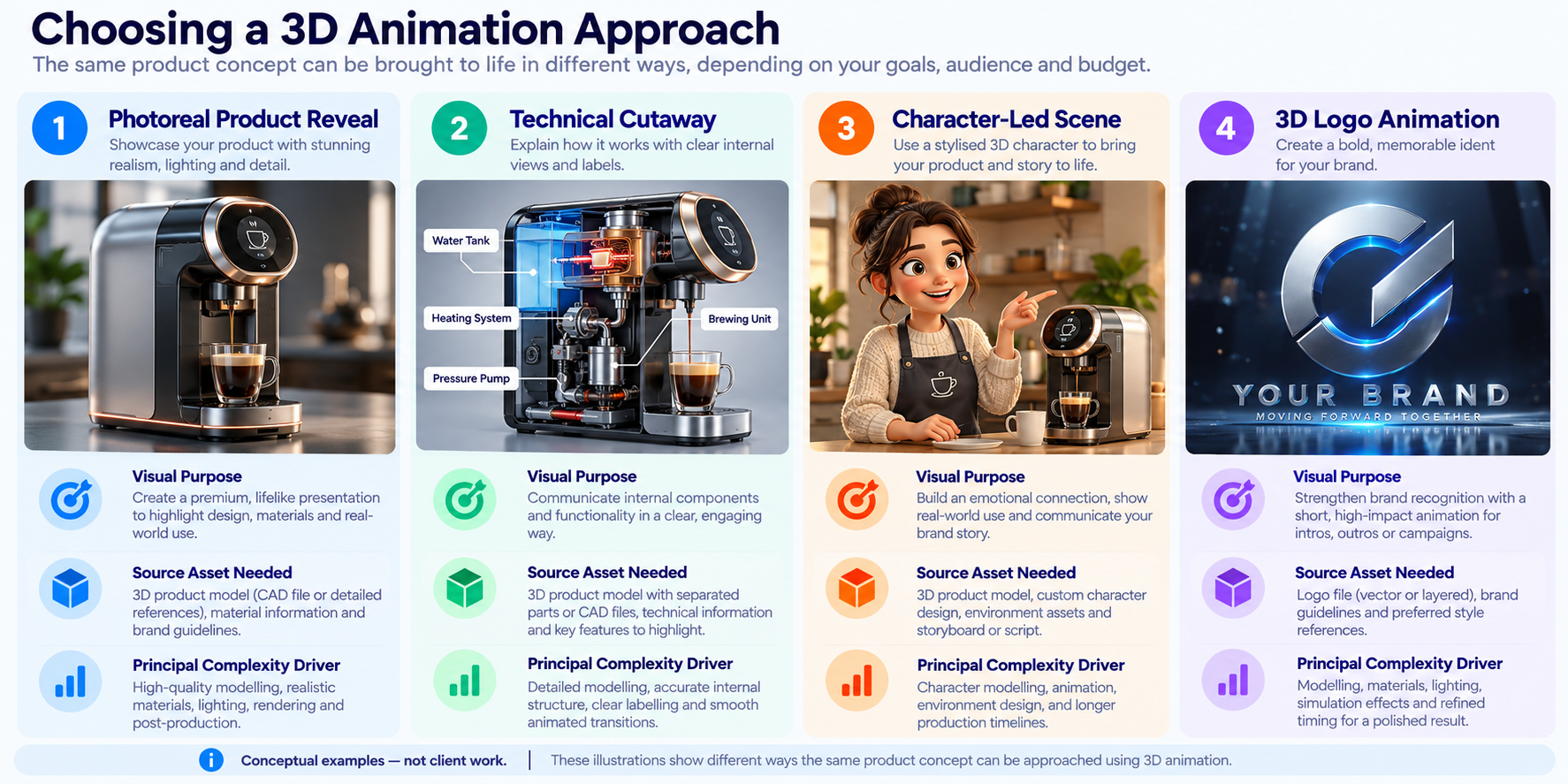
Examples should also be judged at their intended viewing size. Fine mechanical labels can disappear in vertical social content; dramatic reflections can hide a product’s defining shape. Review a still frame at mobile size before committing to a style.
3D Animation for Products, Brands and Business Communication
Commercial 3D animation can serve several different business needs, but each needs its own creative priorities. For a product launch, the challenge may be to make shape, finish and distinctive features recognisable. For an industrial presentation, the challenge may be to explain sequence, flow or assembly. For a brand campaign, the aim may be to create a memorable visual world without relying on a physical location.
Advertising and marketing campaigns
3D animation for advertising can present an object in a controlled environment, introduce dramatic transitions or visualise a concept that would be difficult to film. The format can support paid social, website hero videos, presentations and digital advertising, provided the creative is adapted to each channel. 3D animation for marketing should be planned around the audience’s viewing context: a six-second social message has different demands from a detailed sales presentation.
Corporate and technical communication
Corporate 3D animation can help teams demonstrate a proposed system, communicate an unfamiliar service or illustrate a safety-critical sequence. These projects often need more factual review than a purely decorative campaign. A subject-matter expert should check terminology, component relationships and the order of operations before final rendering.
Product and pre-launch communication
3D animation video production can be useful when product photographs are unavailable or a design is still being refined. However, unfinished specifications create a risk of repeated changes. Agree which features are approved, which are illustrative and whether the animation is intended for internal discussion or public marketing. That distinction affects both the workflow and the wording used around the finished visuals.
3D Product Animation: Modelling, Materials and Movement
3D product animation begins with an accurate enough digital representation of the object for its intended use. The available source material makes a substantial difference. A clean CAD model may supply useful dimensions and component relationships, but it can still need conversion, geometry cleanup and material preparation before it is suitable for animation. Photographs and sketches may be enough for a stylised concept, but modelling from references introduces more interpretation.
Building the digital model
Geometry defines the product’s shape. The modelling approach depends on whether the viewer will see broad silhouettes, close-up details or moving internal parts. An object designed for a distant shot does not always need the same detail as a product filling the frame. Conversely, small modelling errors become obvious when the camera moves close to reflective surfaces.
Materials, lighting and visual credibility
Surface materials influence how the viewer reads glass, metal, rubber, plastic and fabric. Lighting is not just decoration: it reveals form, separates edges and directs attention to important features. A glossy product can look premium in one setup but become difficult to read if reflections conceal its contours. Early style frames help establish an appropriate balance before rendering the entire sequence.
Motion, assembly and technical accuracy
Camera movement, object rotation, exploded views and assembly sequences should each serve a reason. An exploded view can explain component order; a rotation can communicate shape; a cutaway can reveal a hidden function. If an animation claims to demonstrate actual mechanical behaviour, its movement should be reviewed against approved technical information. Visually plausible motion is not necessarily physically correct.
A 3D animation production company should explain which reference assets are required and where approvals occur. For product-led projects, send available CAD files, photographs, drawings, brand guidelines and any restrictions on what can be shown publicly.
3D Character Animation and Brand Personality
A 3D animation character can give a campaign a recognisable voice, but creating convincing character movement is different from rotating a product model. Character projects may require modelling, rigging, skin deformation, facial controls, poses, animation timing and, where dialogue is involved, lip synchronisation.
Rigging is the process of preparing a model to move in a controllable way. A simple mascot with limited gestures may need a relatively straightforward setup; a character expected to speak, walk and convey subtle emotion requires much more attention to joints, facial expressions and performance. The complexity depends not only on how many characters appear, but on what they are expected to do.
For 3D character animation services, a strong brief identifies the personality, audience, tone and likely future use of the character. A character designed for a one-off ident may have different requirements from a reusable campaign mascot. If reuse matters, discuss the scope of source files, alternative expressions and future animation before production starts; these should not be assumed to be included automatically.
3D Logo Animation and Short Brand Idents
A 3D animation logo can add depth, movement and a controlled reveal to a brand identity. A logo 3D animation may involve dimensional lettering, an emblem rotating into view, a lighting change or a brief transformation into a finished mark. The effect works best when it reinforces the existing identity rather than overwhelming it.
Not every flat logo translates well into a three-dimensional object. Fine typography, complex gradients or intricate shapes may need adaptation. Before approving a concept, check whether the mark remains recognisable at small sizes and whether the animation still communicates without sound. A short ident may need a clean background, a transparent-background alternative or multiple aspect ratios, but those are separate deliverable decisions to specify in the quotation.
For some brands, restrained 2D motion graphics will be clearer and more consistent than a dimensional treatment. The decision should follow the brand system and intended placement, not a preference for visual effects alone.
3D Explainer Animation and Technical Storytelling
3D explainer animation is most valuable when spatial relationships matter. A viewer may need to understand how components connect, how a product fits into a larger system or why an internal movement changes the outcome. In those cases, a carefully planned digital camera can make the explanation easier to follow.
Good technical storytelling separates essential information from visual noise. Start with the audience’s existing knowledge, introduce the subject at an understandable scale, then reveal details in a deliberate order. Labels, voiceover and movement should support one another rather than compete for attention.
For example, a conceptual animation of a filtration device could introduce the exterior, highlight the flow path and then reveal an internal cutaway. If the purpose is training or regulated product communication, technical claims and component behaviour require client approval. A visually attractive render cannot substitute for a technical review.
When the primary requirement is a narrative explaining a service or concept rather than a specifically three-dimensional subject, an animated explainer video or a 2D approach may be more economical and easier to update.
2D vs 3D Animation: Choosing the Right Approach
The 2D vs 3D animation decision should begin with the information you need to communicate. Two-dimensional motion is often effective for diagrams, interfaces, text-led explanations and flat brand illustrations. Three-dimensional production becomes useful when depth, rotation, physical materials or spatial relationships are central to the message.
| Decision factor | 2D animation | 3D animation |
|---|---|---|
| Visual focus | Graphic hierarchy, illustration and typography | Depth, volume, lighting and camera position |
| Technical mechanism | Effective for simplified flow diagrams | Useful for assemblies, cutaways and spatial relationships |
| Asset preparation | Often uses vector artwork and design frames | May need models, materials, rigs and scene setup |
| Changes | Some graphic changes can be relatively direct | Geometry, rig or lighting changes can affect several stages |
| Visual realism | Typically illustrative | Can be stylised or photorealistic |
Consider two 2D vs 3D animation examples. A company explaining how to submit an online request may need simple icons, interface-style screens and clear labels: 2D could be sufficient. A manufacturer explaining how three moving parts fit together may benefit from a 3D cutaway. Neither technique is inherently more effective; suitability depends on the message.
A hybrid approach can also work. A 3D product may sit alongside 2D annotations, diagrams and captions. This can preserve a sense of physical form while keeping the explanation legible. Hybrid work still needs clear decisions about what is dimensional and what remains graphic.
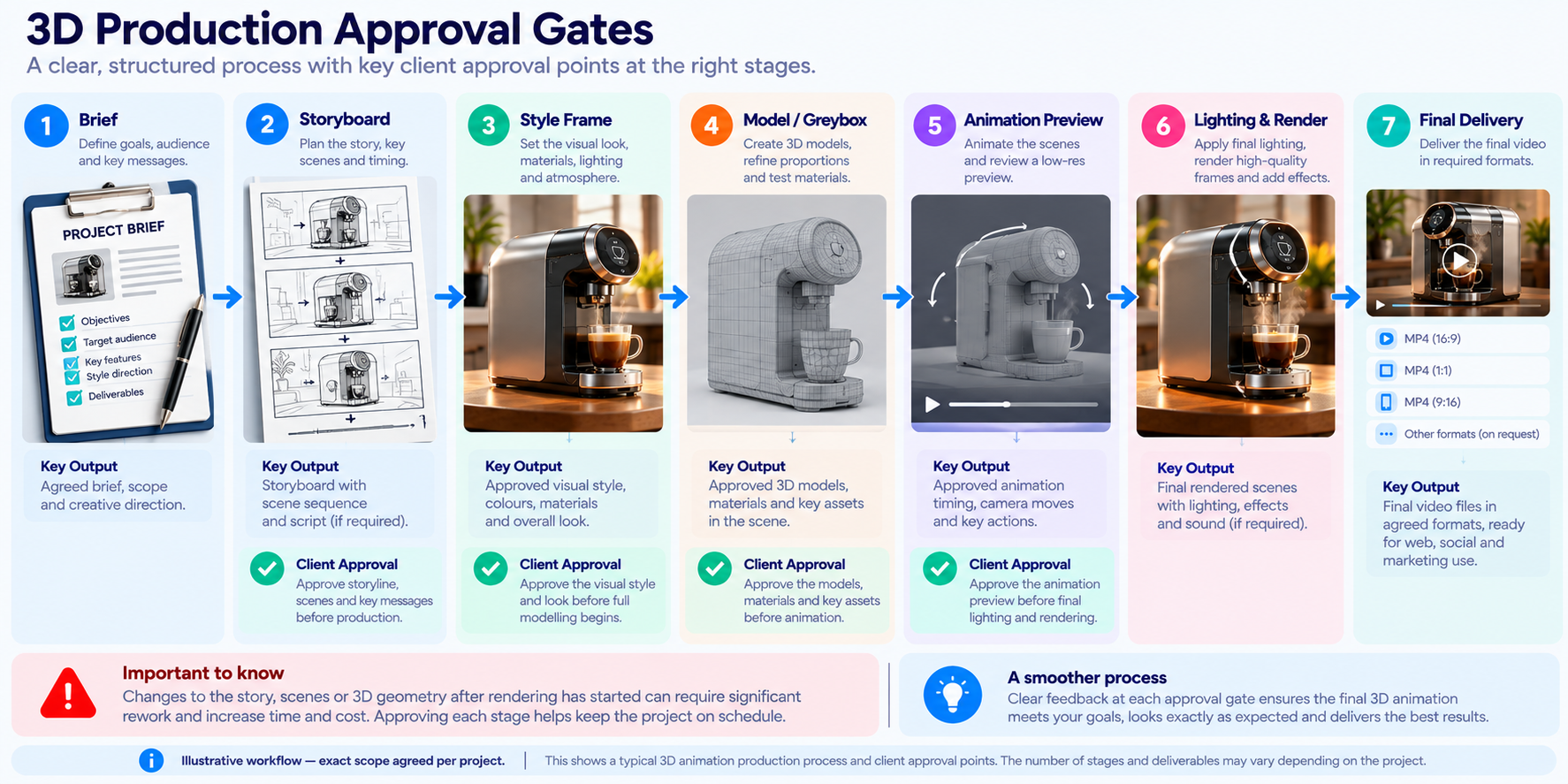
Our Recommended 3D Animation Production Process
A reliable 3D animation production process includes decision points before the most expensive work is completed. The precise workflow varies with the project, but the stages below offer a useful framework for discussing scope and approvals.
1. Define the brief and reference material
Agree the audience, key message, duration, channels, visual style and any factual or brand restrictions. Identify available drawings, models, images and scripts. If product specifications are still changing, determine what can safely be approved now and what should remain flexible.
2. Establish the story and visual direction
A storyboard or shot plan defines what appears and in what order. Style frames establish the intended level of realism, materials, colour and lighting. These decisions are easier to discuss before every scene has been modelled and rendered.
3. Prepare models and scenes
Depending on the project, existing geometry may be converted and cleaned, or new assets may need to be modelled. The team must decide how much detail is necessary for the camera distance and final resolution. Technical subjects may require a separate client accuracy review.
4. Review movement before final rendering
Blocking or preview animation tests the timing, framing and sequence. A low-detail preview is often enough to reveal whether a mechanism is understandable or whether the camera moves too quickly. Late changes to scene structure can require substantial rework, so this is an important approval stage.
5. Finalise materials, lighting and render
Once the motion is approved, materials, lighting, rendering and compositing can be refined. Rendering converts the digital scene into image frames; complexity, image quality and resolution affect processing demands. Sound, captions and graphics may also be considered where included in the agreed scope.
6. Review outputs and deliver agreed files
Final checks should consider spelling, logos, visual continuity, technical claims, framing, sound and intended platform. The handover should specify exactly which exports are being delivered. Future edits may depend on whether editable project assets are retained or included.
What Files, Formats and Deliverables Should You Plan For?
The word “video” can hide several separate requirements. A website hero animation, social advert, sales presentation and exhibition screen may need different framing, lengths, file specifications and sound treatments. These should be discussed early, because changing the aspect ratio can require recomposing a scene rather than simply cropping it.
| Potential deliverable | Typical use | Confirm before production |
|---|---|---|
| Main rendered video | Website, presentations or campaign landing page | Duration, resolution, frame rate and audio |
| Vertical or square version | Social advertising and mobile placements | Reframing, text-safe areas and any shorter edit |
| Still renders | Product pages, campaign artwork or presentations | Number of views, background and image dimensions |
| Transparent-background output | Compositing an animated element over other footage | Supported codec, alpha channel and compatibility |
| Editable source assets | Potential future adaptations | Ownership, software compatibility, licences and handover scope |
Depending on the agreed brief, a project may involve a master animation, shorter cut-downs, alternate aspect ratios, still frames or additional versions. None should be assumed to be included without written confirmation. If the animation will appear across multiple channels, supply the platform requirements before camera framing is finalised.
Have CAD files, product references or a draft script? Share them with your enquiry so the required modelling and production work can be assessed more accurately.
3D Animation Cost in the UK: What Affects Pricing?
There is no universal 3D animation price per minute. A short sequence showing a simple object turning on a plain background can require much less work than a short character performance with facial animation, a complex environment and photoreal lighting. Duration matters, but asset complexity and the type of movement can matter just as much.
For 3D animation cost UK enquiries, a quotation should describe the proposed scope rather than rely on an unqualified per-minute rate. The most useful cost discussion begins with the amount of original modelling, the intended visual finish and the approval process.
| Price driver | Why it affects scope | What to provide |
|---|---|---|
| Existing 3D assets | Usable models may reduce creation work; unsuitable files may need rebuilding | CAD, model files, drawings and product photos |
| Visual realism | Detailed materials, lighting and close-ups need additional refinement | Style references and required accuracy |
| Character performance | Rigging, expressions and dialogue add specialist animation work | Character brief, script and performance references |
| Scene and camera complexity | Multiple environments and difficult transitions increase production work | Storyboard or key messages |
| Output versions | Different formats can require revised framing, edits and exports | Channels, ratios and platform specifications |
| Approvals and revisions | Late structural changes can affect modelling, animation and rendering | Decision-makers and sign-off process |
When comparing 3D animation pricing, check whether proposals cover script development, modelling, animation, sound, revisions, different formats and source-file rights. A low headline figure may not include the same work as a higher quotation. A credible estimate should make those boundaries visible.
Prime Lion Digital’s starting price for this specific service has not been confirmed here, so no fixed “from” figure is stated. Request a project-specific quotation with your desired length, visual references and available assets.
How to Brief a 3D Animation Studio
A good brief helps a 3D animation studio focus on the right problem and reduces the risk of quoting for the wrong level of complexity. You do not need to know every technical term. You do need to explain what the audience should understand after watching.
- Purpose: What should the viewer know, feel or do?
- Audience: Are viewers consumers, technical buyers, staff or investors?
- Subject: What object, character, system or process needs to appear?
- Accuracy: Which dimensions, movements, claims or colours must be exact?
- References: Do you have CAD files, photographs, scripts or visual inspiration?
- Style: Should the result be realistic, stylised, technical or playful?
- Distribution: Which websites, advertising channels or screens will use it?
- Approvals: Who can sign off story, design, technical accuracy and final output?
- Timing and budget: Is there a fixed launch date or a budget range to work within?
When comparing 3D animation studios UK-wide or searching for 3D animation studios London, prioritise relevant specialist experience, clarity about scope and evidence of a workable approval process. A London search term does not by itself mean the production needs to happen in London: much of the planning and review for CGI can take place remotely.
Why Work with Prime Lion Digital?
Prime Lion Digital positions 3D animation within a wider digital and video-production offering. That can be useful when the final animation needs to fit a website, digital campaign or broader content programme rather than exist as an isolated video. The creative brief should still establish the specialist production requirements for the specific project.
When evaluating any 3D animation company UK supplier, ask for examples that match your intended application and a quotation that separates asset creation, animation, finishing and output versions. Also confirm who will review technical accuracy and how changes will be handled. These practical questions are more meaningful than unsupported claims about being the “best” studio.
For your enquiry, explain the commercial context and share what you already have. That provides a sound basis for deciding whether full 3D, a simpler motion-graphics approach or a combination would be most suitable.
Frequently Asked Questions About 3D Animation
What is the difference between a 3D animation company and a 3D animation studio?
The terms are often used interchangeably in supplier searches. What matters more is the provider’s relevant production experience, the specific work included in the quote and whether it can support your intended style. A studio focused on product CGI may have a different skill set from one specialising in character animation.
How much does 3D animation cost in the UK?
Costs vary according to modelling, complexity, realism, animation, duration, revisions and output requirements. A per-minute figure can be misleading without knowing whether new assets and environments must be created. Share a brief and references to obtain a scoped estimate.
Can you calculate a 3D animation price per minute?
It can be used as a rough comparison once the production approach is defined, but it is not a reliable standalone pricing model. A 20-second sequence with a highly detailed character can require more work than a longer animation built from simple reusable objects.
What do I need to supply for 3D product animation?
Useful inputs include product photographs, CAD models, technical drawings, approved dimensions, material references and brand guidelines. If those are unavailable, explain what can be inferred and what must be confirmed before the animation is treated as an accurate product representation.
Can 3D animation show a product that has not been manufactured?
Yes, a digital concept can represent a planned product, provided suitable design information exists. The result should be described accurately as a visualisation if details are provisional. Any functional claims or final specifications need appropriate client approval.
Is 3D animation better than 2D for marketing?
Not universally. 3D is useful for volume, materials and spatial relationships; 2D can be clearer for diagrams, text and interface-led explanations. Choose according to what the audience needs to understand and the resources available for production.
How long does 3D animation production take?
Timing depends on the number of assets, modelling readiness, visual complexity, animation length and the speed of approvals. A reliable schedule should identify milestones for the storyboard, style frames, model approval, animation preview and final render rather than promise the same turnaround for every project.
Can one 3D animation be used on a website and social media?
Potentially, but versions may need different framing, duration, captions or graphics. Plan for landscape, square or vertical placement before camera movements are finalised. Simply cropping a widescreen animation can hide essential information.
Will we receive the editable 3D files?
That depends on the agreed contract and the licences attached to any assets or software-dependent elements. Rendered videos and editable project files are different deliverables. If future editing or reuse matters, discuss rights and source-file handover before commissioning.
Do you need a script before requesting a quotation?
A final script is not always essential for an initial conversation, but a short outline of the key message, audience and required scenes is valuable. The more clearly you can describe the intended result, the easier it is to distinguish essential work from optional creative additions.
Discuss Your 3D Animation Project
If you are planning a product reveal, technical explanation, character-led campaign or short brand ident, begin with the communication objective. Tell Prime Lion Digital what you need to show, who will watch it, where it will appear and whether you already have models, drawings or visual references.
Use the enquiry form above to request a discussion of suitable production options and a project-specific 3D animation quotation. A clear brief makes it easier to select an approach that fits both the message and the intended budget.