Tell us a little about what you’re looking for, and our team will be in touch to discuss how we can help.
Professional Video Storyboarding Services in the UK
Plan what your audience will see before filming or animation begins. Prime Lion Digital provides storyboarding services to help businesses, marketing teams and production professionals develop clear visual sequences, review camera compositions and prepare creative ideas for production.
Our storyboarding work can start from an existing script, a creative concept or a production brief. We help translate written ideas into visual frames that communicate shot order, framing, action and important transitions.
Storyboarding services from £300. The final quotation depends on the number of frames, complexity, illustration detail and agreed deliverables.
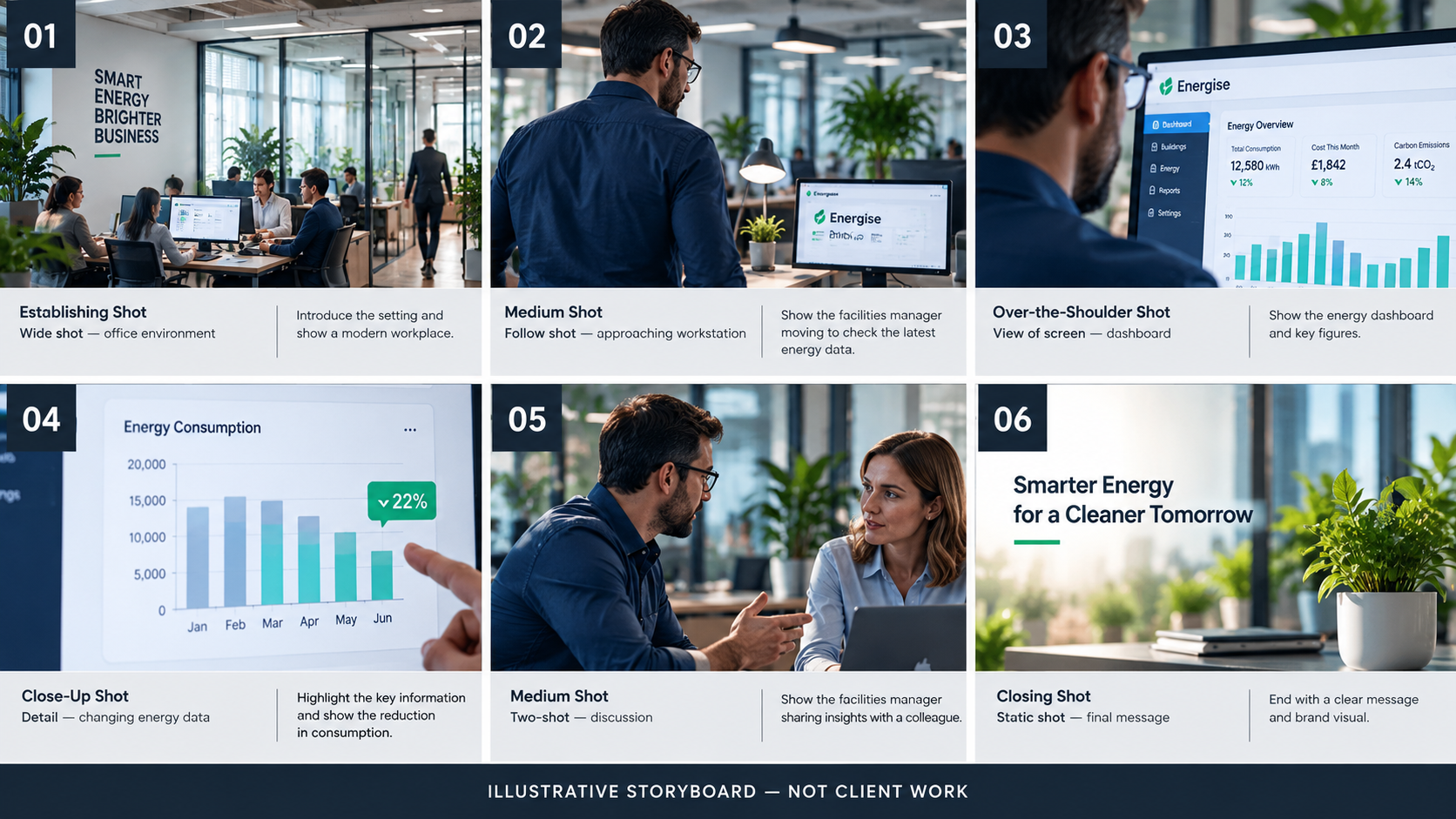
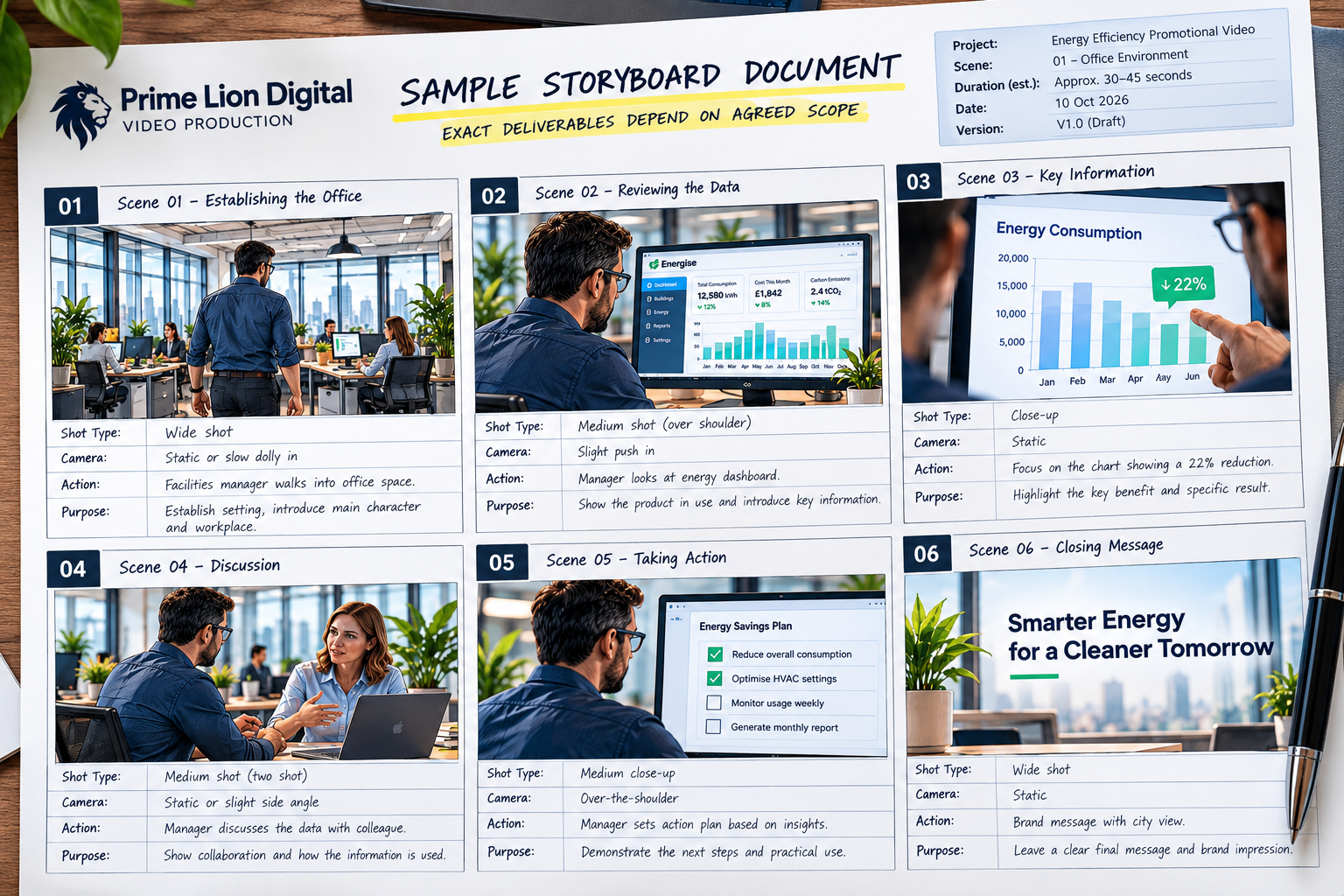
A Six-Frame Storyboard Example
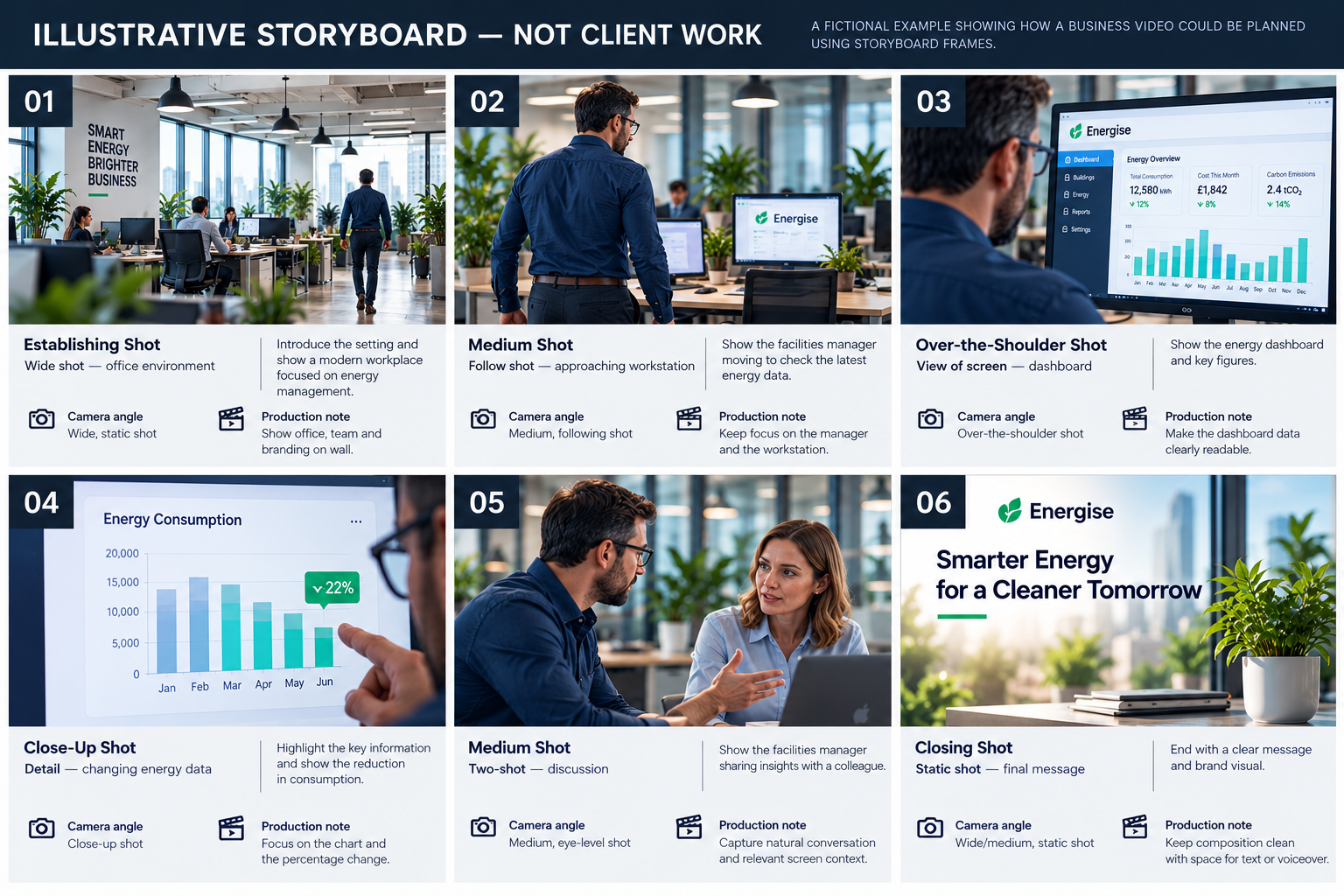
A storyboard turns an idea into a sequence of visual decisions. The example below follows a fictional business video about monitoring energy consumption in a workplace. Each frame has a specific purpose, from establishing the setting to showing the product interface and ending with a clear closing message.
What the sequence demonstrates
The opening frame establishes context. The next two frames introduce the person and the information they are viewing. A close-up draws attention to the most important detail, while the reaction shot reconnects the information to the people using it. The final composition leaves space for the intended closing message.
These decisions help a production team discuss what each shot needs to communicate before committing to filming, illustration or animation.
Why Storyboarding Matters
Professional storyboarding gives stakeholders a practical way to examine the proposed video rather than relying entirely on a written description.
Clearer Creative Approvals
Marketing managers, clients and producers can review the same visual sequence and discuss specific frames, compositions and transitions. Feedback becomes more precise than a general comment about the overall concept.
More Focused Shot Planning
Storyboard frames establish which views are needed and how they connect. A wide shot may introduce a location, while a close-up may reveal a product feature or important action.
Earlier Identification of Visual Gaps
A sequence may look complete in a script but leave unanswered questions about movement, continuity or how information appears on screen. Storyboarding creates an opportunity to address those questions during pre-production.
A Shared Production Reference
Directors, camera operators, editors, animators and client stakeholders can use an agreed storyboard as a reference for the intended sequence. The level of detail should reflect who needs to use it and what decisions remain open.
Where Storyboarding Is Useful
Corporate and Promotional Video Storyboarding
Business videos often need to explain a service, demonstrate a product or communicate a specific message. Storyboarding helps organise interview sequences, workplace footage, product demonstrations and planned visual transitions.
Film and Cinematic Storyboarding
Film storyboarding is useful when camera placement, movement, scene geography and continuity are important. Visual planning helps communicate how one shot connects to the next, especially where a sequence contains several actions or viewpoints.
Storyboarding for Animation and Motion Graphics
Animation storyboarding establishes the visual order of scenes before detailed animation work begins. It can clarify changes in composition, character action, on-screen information and transitions. Motion design and finished animation remain separate production activities.
Music Videos and Creative Productions
Music video storyboarding can organise performance shots, narrative moments, visual motifs and planned changes in setting. The amount of detail depends on the creative treatment and the complexity of the sequence.
Storyboarding for YouTube and Digital Video
YouTube videos, social campaigns and digital adverts can benefit from visual planning when they involve demonstrations, multiple scenes, scripted action or graphics. Simpler presenter-led videos may need only a short shot outline rather than a detailed illustrated board.
Storyboard Formats Compared
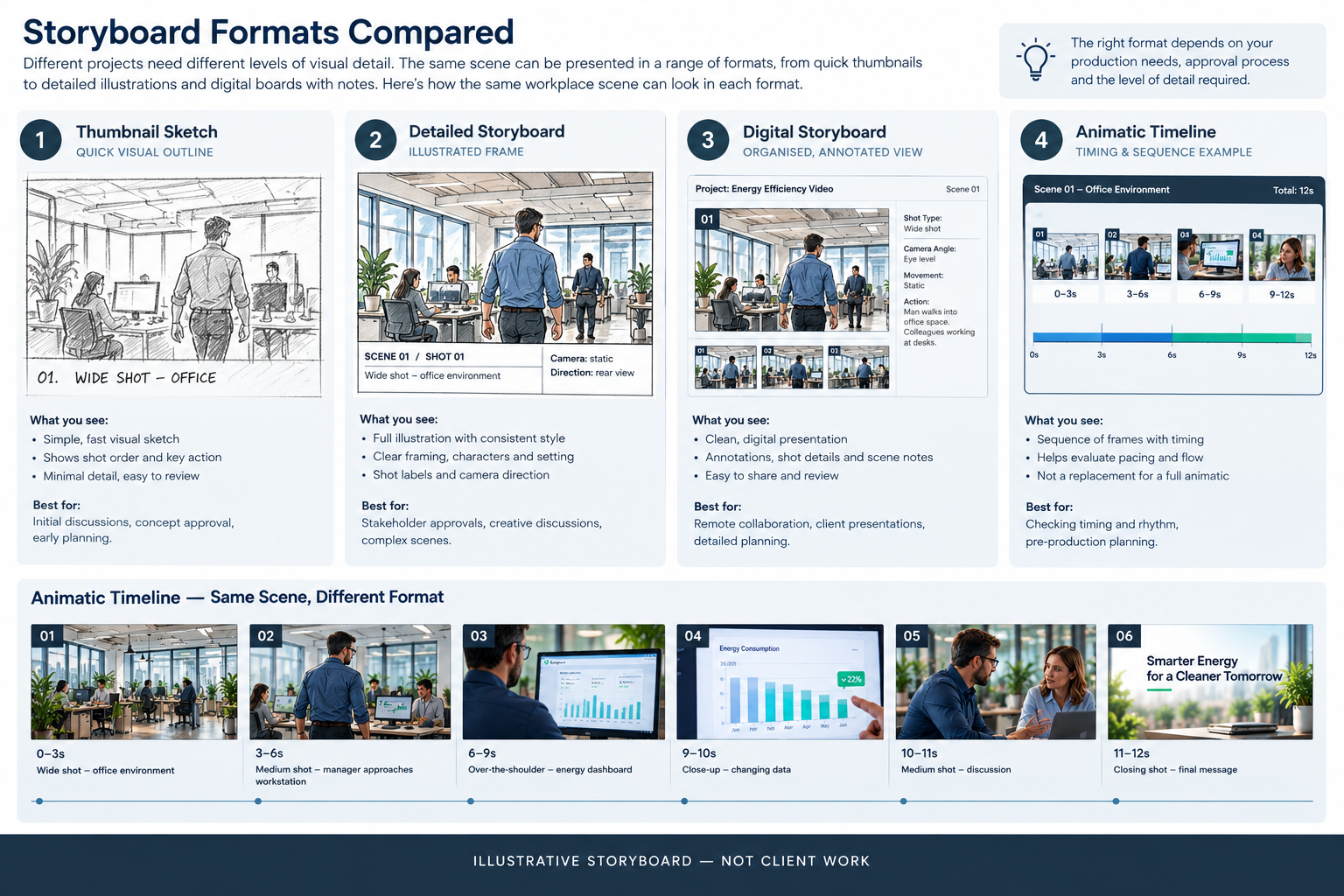
Different projects need different levels of visual detail. A rough thumbnail may be enough to agree the order of shots, while a complex scene may require more precise drawings and annotations.
| Approach | Best suited to | Main consideration |
|---|---|---|
| Thumbnail storyboards | Early shot sequencing and concept discussions | Quick to review but limited in visual detail |
| Detailed storyboards | Complex compositions and stakeholder approvals | Greater illustration detail requires additional work |
| Digital storyboard presentation | Organised sharing, annotation and review | Digital presentation does not automatically mean greater detail |
| Animatic | Reviewing timing, pacing and approximate movement | A separate timed output, not automatically included |
The most useful format is the one that answers the project’s production and approval questions. The chosen presentation and level of detail are agreed as part of the quotation.
What Our Storyboarding Service Can Involve
Brief and Script Interpretation
We examine the intended message, audience, scene requirements and available creative materials to identify what needs to be communicated visually. A completed script can provide a starting point, but an initial concept or production brief may also be suitable for discussing the project.
Scene Breakdown and Shot Sequencing
Scenes are divided into planned visual moments. This establishes the order of shots and identifies where a change in framing, viewpoint or location is needed.
Storyboard Design and Composition
Frames communicate the proposed arrangement of people, objects and visual information. Depending on the agreed scope, this can include wide shots, medium shots, close-ups, screen compositions and directional cues.
Camera and Action Notes
Annotations may describe movement, framing, key actions and transitions where those details are needed to interpret the sequence. The required level of annotation is established during scoping.
Review and Refinement
The storyboard can be reviewed against the brief and adjusted within the agreed revision scope. This helps ensure that the approved visual sequence reflects the intended creative direction.
From Script to Storyboard: Turning Words into Shots
A script describes what happens and what the audience needs to understand. A storyboard explores how that information should appear on screen.
Illustrative script direction: “The facilities manager checks the latest energy figures and identifies a change in consumption.”
That single sentence could become three different shots:
- Medium shot: Establish the manager at the workstation and make the action understandable.
- Over-the-shoulder shot: Connect the person to the dashboard being examined.
- Close-up: Emphasise the relevant change in the fictional energy chart.
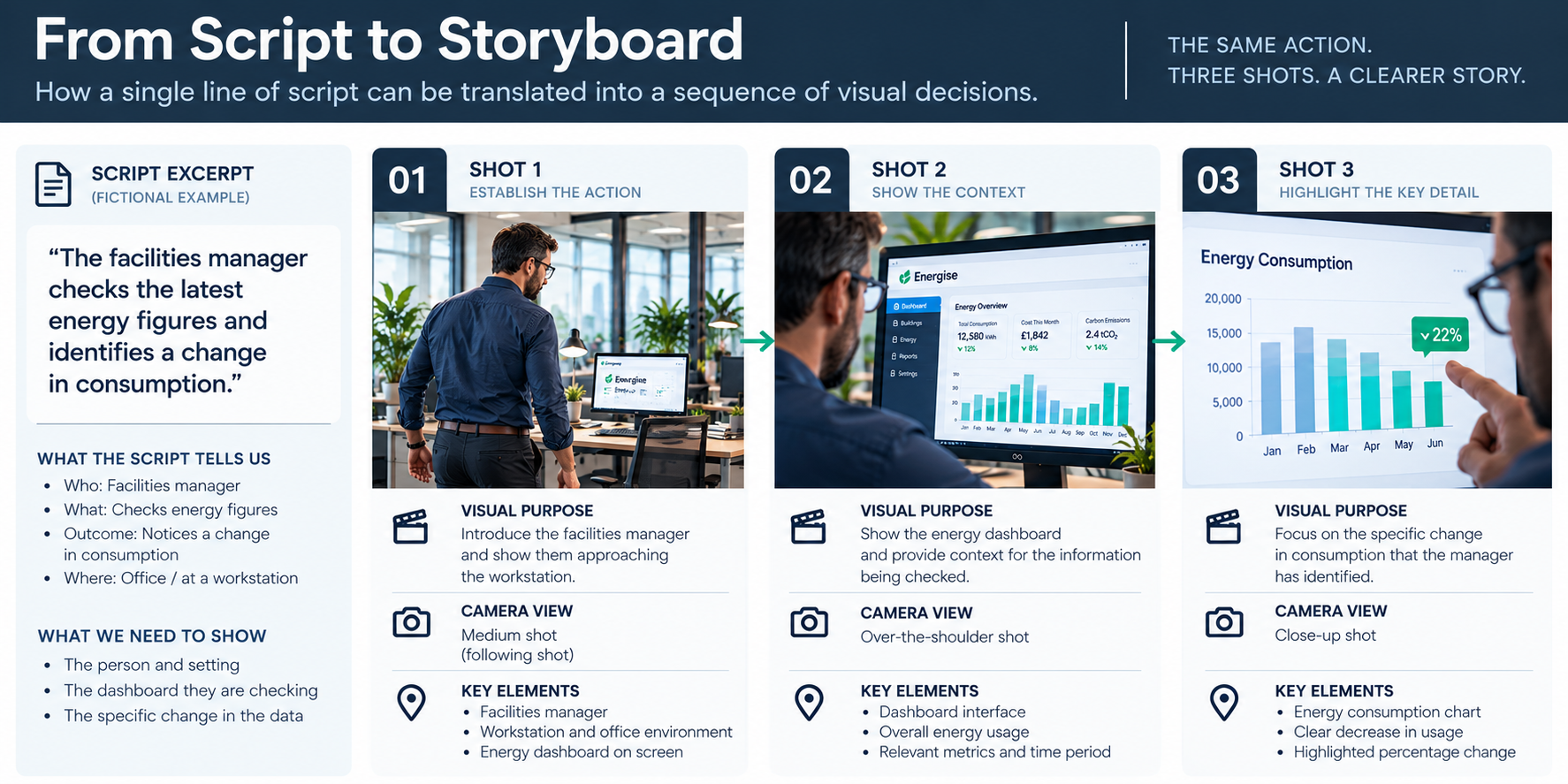
Storyboarding does not replace scriptwriting. It provides a visual interpretation of the material. If the written narrative still needs development, our video scriptwriting services address that separate requirement.
Camera Angles, Composition and Visual Continuity
A storyboard artist or creative team must decide what each frame reveals and how viewers will interpret it. Three views of the same action can communicate different information.
Wide Shot: Establish the Situation
A wide composition shows the environment and the relationship between people and objects. It helps viewers understand where the action is taking place.
Medium Shot: Show the Action
A medium composition places greater emphasis on the person and their interaction with the surroundings. It is often useful when the action matters more than the wider location.
Close-Up: Direct Attention
A close-up isolates a specific detail, such as a product feature, facial expression or piece of information. The surrounding sequence must establish enough context for the detail to make sense.
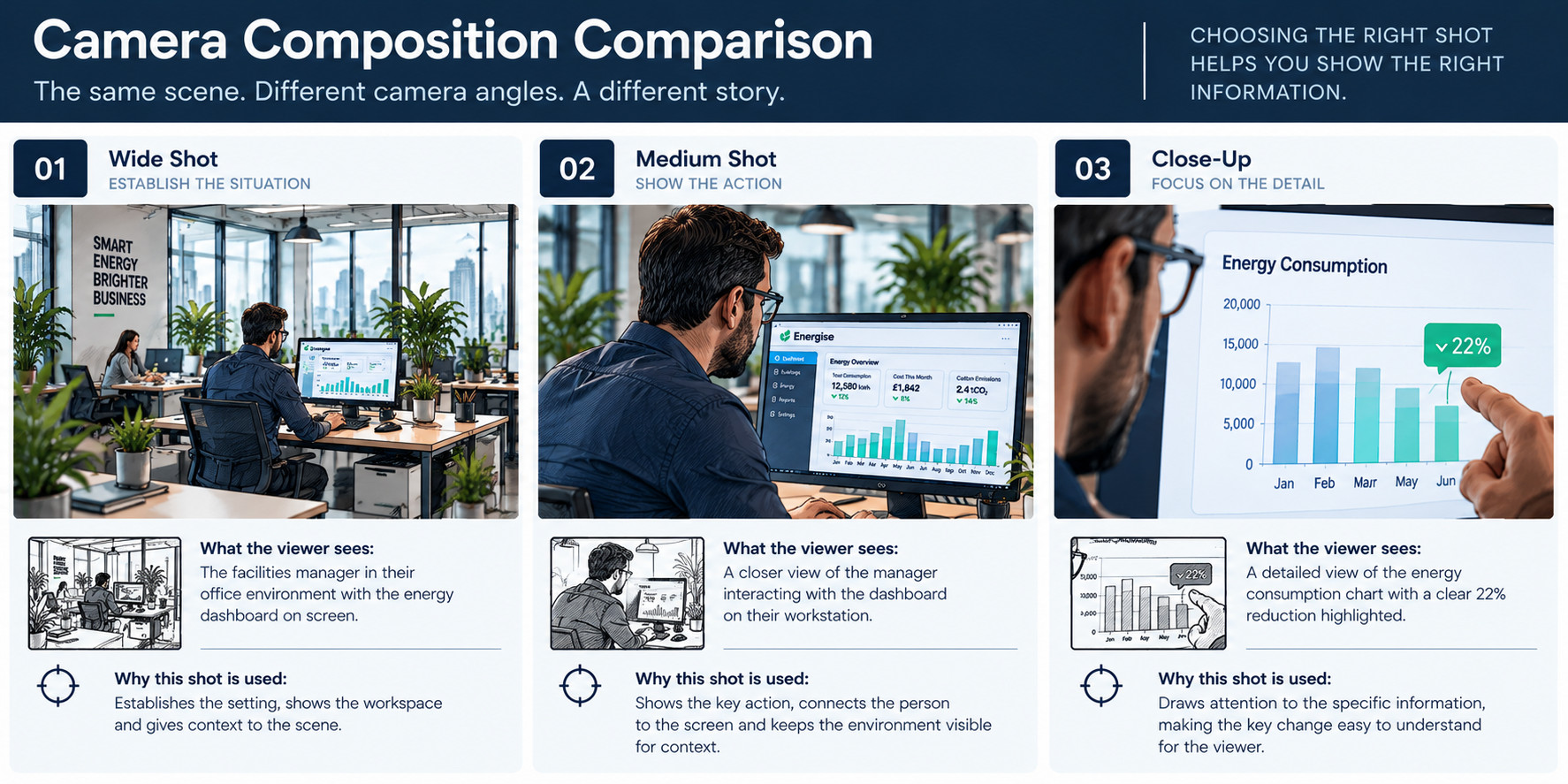
Continuity matters as much as individual framing. If a person moves from left to right in one shot, the following shot should be planned with screen direction in mind. Camera movement and transitions also need to support the intended visual logic.
Have a script or concept ready? Share Your Script or Concept so we can discuss the storyboard detail your production requires.
Our Storyboarding Process
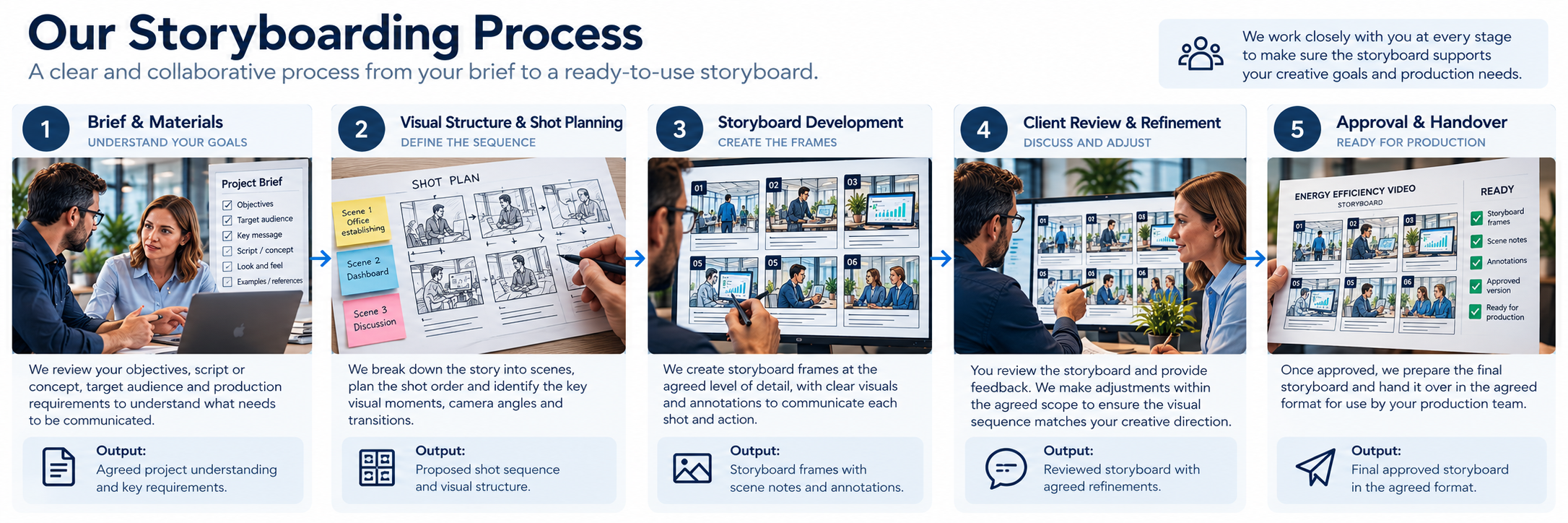
Storyboarding is developed around the material available, the production decisions that need approval and the final level of detail agreed with the client.
- Brief & Materials: Review the creative objective, script or concept, intended audience and production requirements. The initial output is an agreed understanding of the visual brief.
- Visual Structure & Shot Planning: Identify key scenes, shot order and important changes in viewpoint. The working output is a proposed visual sequence.
- Storyboard Development: Prepare the storyboard frames and agreed annotations at the selected level of detail.
- Client Review & Agreed Refinement: Collect feedback and address revisions within the agreed scope, focusing on sequence, composition and clarity.
- Approval & Handover: Prepare the agreed storyboard output for client approval and use by the relevant production team.
What You Receive from a Storyboarding Project
The central output is an agreed visual sequence presented as storyboard frames. The exact number of frames, level of illustration detail, annotations and handover format are established in the project quotation.
| Output | How it is handled |
|---|---|
| Storyboard frames | Core visual sequence; frame count and detail are defined in the quotation |
| Shot numbering and scene notes | Included to the level agreed for the project |
| Detailed illustrations and additional annotations | Scope-dependent, based on production needs |
| Document and handover format | Confirmed before work begins |
| Scriptwriting, animatics and finished video production | Separate requirements unless specifically included in the quotation |
Storyboarding Rates and Project Timelines
Professional storyboarding from £300.
The starting price is an entry point for discussing the service, not a fixed package with a guaranteed number of frames or revisions. We assess the creative brief and required output before providing a project-specific quotation.
| Cost factor | Why it matters |
|---|---|
| Number of frames | More scenes and individual shots require additional visual development |
| Scene complexity | Multiple characters, locations, movements or detailed environments increase planning requirements |
| Illustration detail | Simple thumbnails and carefully rendered compositions require different amounts of work |
| Review and revisions | The agreed feedback and refinement scope affects the project workload |
| Additional outputs | Extra annotations, presentation requirements or separately quoted timed previews change the scope |
How Long Does Storyboarding Take?
Timing depends on the readiness of the script or brief, the number and complexity of scenes, the required visual detail and the review process. A project schedule is agreed after these requirements have been assessed.
Expert Insight: Choosing the Right Level of Storyboard Detail
What We See
A highly detailed illustration is not automatically a more useful storyboard. A simple frame with a clear camera note can communicate a straightforward shot more effectively than a polished drawing that leaves the intended action ambiguous. Conversely, complex scenes may need precise composition and movement notes to make the visual sequence understandable.
Why It Matters
The storyboard must serve the people making decisions. A marketing manager may need to approve the overall narrative and visual emphasis. A filming team may need practical guidance on framing, shot order and screen direction. An animation team may need more explicit scene transitions and visual states.
What We Recommend
Decide which questions the storyboard must answer before selecting the illustration style. Begin with the sequence and its purpose, then add detail where it changes a production decision or makes approval easier. This keeps attention on visual communication rather than illustration polish for its own sake.
Related Video Production Services
Video Strategy & Concepts
For projects that need the creative direction and message established before visual planning begins. [INTERNAL LINK URL REQUIRED — Video Strategy & Concepts]
Video Scriptwriting
For developing dialogue, narration and written scene descriptions that a storyboard can translate into visual frames. Explore our video scriptwriting services.
Pre-Production Services
For broader planning and preparation beyond the storyboard itself. Pre-Production Services
Video Production
For filming and producing the finished video after the creative material has been planned and approved. Explore our video production services.
Motion Graphics & Animation
For producing animated visual content from an agreed concept and production scope. Motion Graphics & Animation
Storyboarding FAQs
What is storyboarding?
Storyboarding is the process of planning a video or visual sequence using a series of frames. Each frame represents an intended shot or visual moment and may include notes about action, camera angle, movement and transitions.
Do I need a storyboard for every video?
No. A straightforward presenter-led video may need only a shot list or simple outline. Storyboarding is particularly useful when a production involves multiple scenes, planned camera compositions, complex action, animation or detailed stakeholder approvals.
Is storyboarding part of pre-production?
Yes. Storyboarding is normally a pre-production activity because it helps establish the intended visual sequence before filming or animation begins.
Can you create a storyboard from an existing script?
An existing script can provide a clear starting point for storyboard development. A creative concept or production brief may also be suitable, depending on how much visual and narrative planning remains to be done.
What types of storyboarding are available?
Common approaches include rough thumbnail storyboards, more detailed illustrated frames and digitally presented boards. The appropriate approach depends on the project’s complexity and approval requirements. Digital presentation and illustration detail are separate choices.
What is the difference between a storyboard and an animatic?
A storyboard is primarily a sequence of static visual frames. An animatic places storyboard images into a timed sequence, sometimes with temporary audio, to help evaluate pacing and approximate movement. An animatic is not automatically included in storyboarding.
What is the difference between storyboarding and screenwriting?
Screenwriting develops the written narrative, dialogue and scene descriptions. Storyboarding plans how those scenes or actions appear visually. The two activities support each other but produce different outputs.
How much does storyboarding cost, and how long does it take?
Prime Lion Digital advertises storyboarding services from £300. The final price and delivery schedule depend on frame count, scene complexity, illustration detail, agreed revisions and additional outputs. A quotation defines the project-specific requirements.
Discuss Your Storyboarding Project
If you are planning a corporate video, promotional campaign, animated explainer, product demonstration or other visual production, share the material you already have. A script, creative concept or production brief is enough to begin discussing the storyboarding requirements.
Tell us what the video needs to communicate, who will review the storyboard and which production decisions need to be resolved. We can then discuss the appropriate level of detail and provide a quotation based on the agreed scope.
Storyboarding from £300.