
B2B Website Design for UK Businesses
B2B websites need to do more than present a company professionally. They need to help different decision-makers understand what you offer, find information relevant to their priorities, evaluate your expertise and identify a clear next step.
Prime Lion Digital designs B2B websites around those decisions — bringing together clear information architecture, user journeys, visual design and responsive behaviour in a website that supports the way your business communicates and sells.
B2B Website Design from £1,200
Discuss Your B2B Website | View Our Work
Why B2B Websites Become More Complex
The challenge is therefore not simply fitting more information onto the website. The information needs to be organised so that different visitors can find an appropriate route without first understanding how your company is structured internally.
Selected Website Work
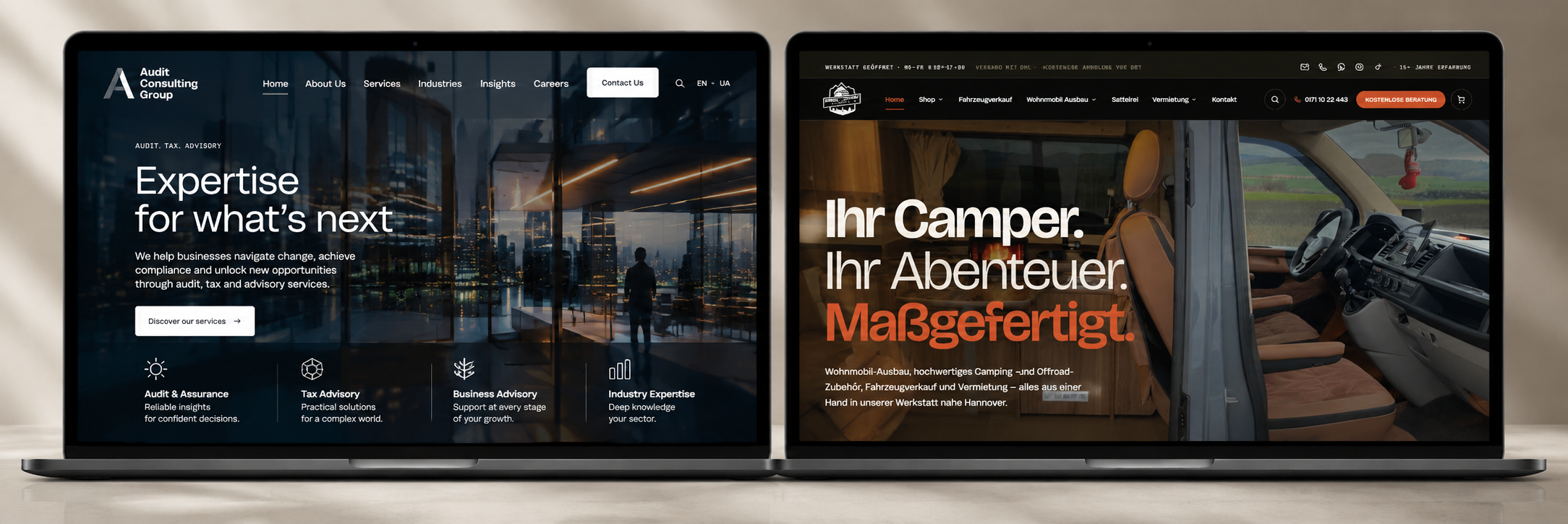
Audit Consulting Group
Audit Consulting Group is a verified Prime Lion Digital project. Its website provides useful visual evidence of how a service-led organisation can present a substantial range of information through a structured website interface.
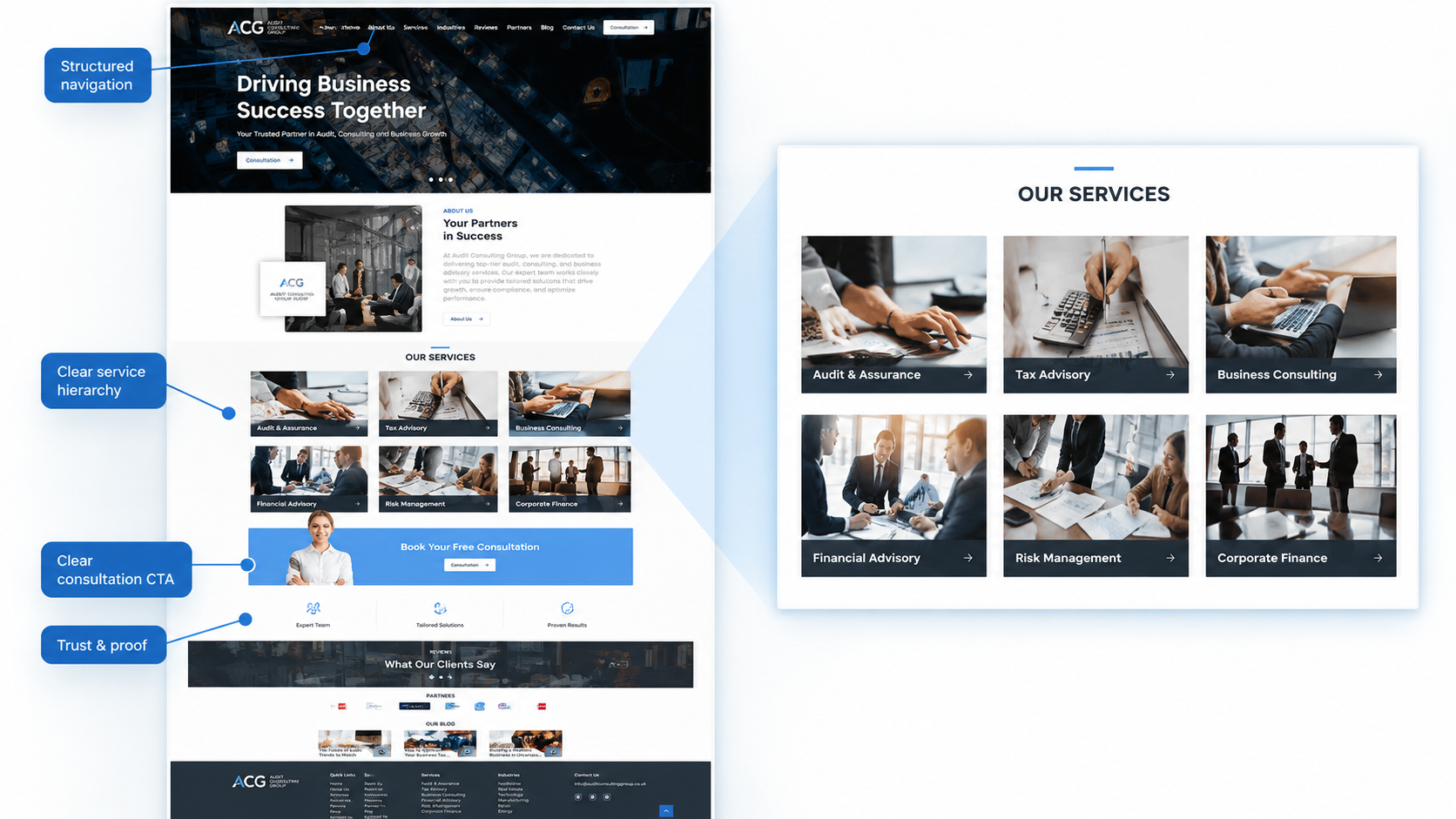
What to notice: how the interface separates top-level company navigation from deeper service information, and how headings, content groups and calls to action help visitors move from an overview towards more specific information.
Construction & Repair Work
Construction & Repair Work is another verified Prime Lion Digital project. It provides a second visual reference for evaluating how PLD approaches hierarchy, page presentation and commercial website design in a different business context.

What Should a B2B Website Help Your Business Do?
Explain Your Proposition Clearly
Visitors should be able to understand what your business does, who it serves and where the relevant service, capability or solution sits within the wider offer.
Create Routes for Different Stakeholders
Not every visitor arrives with the same question. The website structure can provide different routes into the same business without fragmenting the overall experience.
Put Relevant Evidence in the Right Places
Case studies, project examples, expertise, service detail and other available proof are more useful when they appear where a buyer is likely to need reassurance or additional information.
Make the Next Step Clear
Calls to action should reflect the commercial journey. Depending on the page and visitor, that may mean making an enquiry, discussing requirements, requesting further information or moving deeper into the website.
Who Is B2B Website Design For?
Professional Services Businesses
For organisations that need to explain several services while maintaining a coherent company proposition and giving prospective clients a clear route to relevant expertise.
B2B SaaS and Technology Businesses
For businesses where commercial, operational and technical stakeholders may evaluate the same proposition from different perspectives and need different levels of information.
Industrial and Manufacturing Businesses
For companies that need to organise detailed capabilities, applications or technical information without making the commercial journey unnecessarily difficult.
Multi-Service B2B Companies
For businesses whose website needs to connect multiple services, audiences or areas of expertise within one understandable structure.
If the main requirement is replacing an existing website that no longer works for the business, WEBSITE REDESIGN should provide the more specific redesign route.
How We Structure a B2B Website
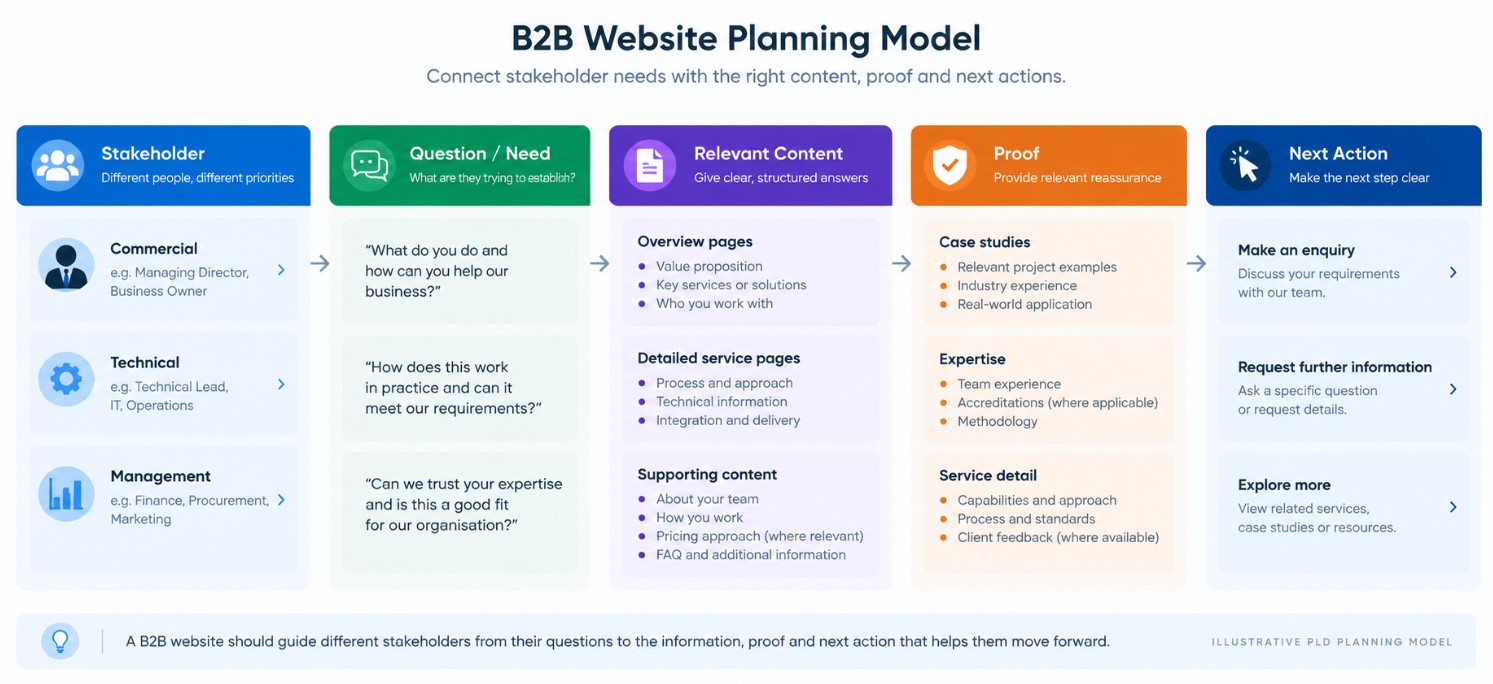
Stakeholder
Identify the people who need to use the website and the commercial or informational context in which they arrive.
Question or Need
Consider what each important visitor is trying to establish rather than expecting them to understand the company’s internal structure.
Relevant Content
Organise services, capabilities, supporting information and page relationships around those needs.
Proof
Position available evidence where it can help a visitor evaluate the business rather than isolating all proof in one part of the website.
Next Action
Give the visitor a logical way to continue once they have enough information to take the next step.
Responsive B2B Website Design
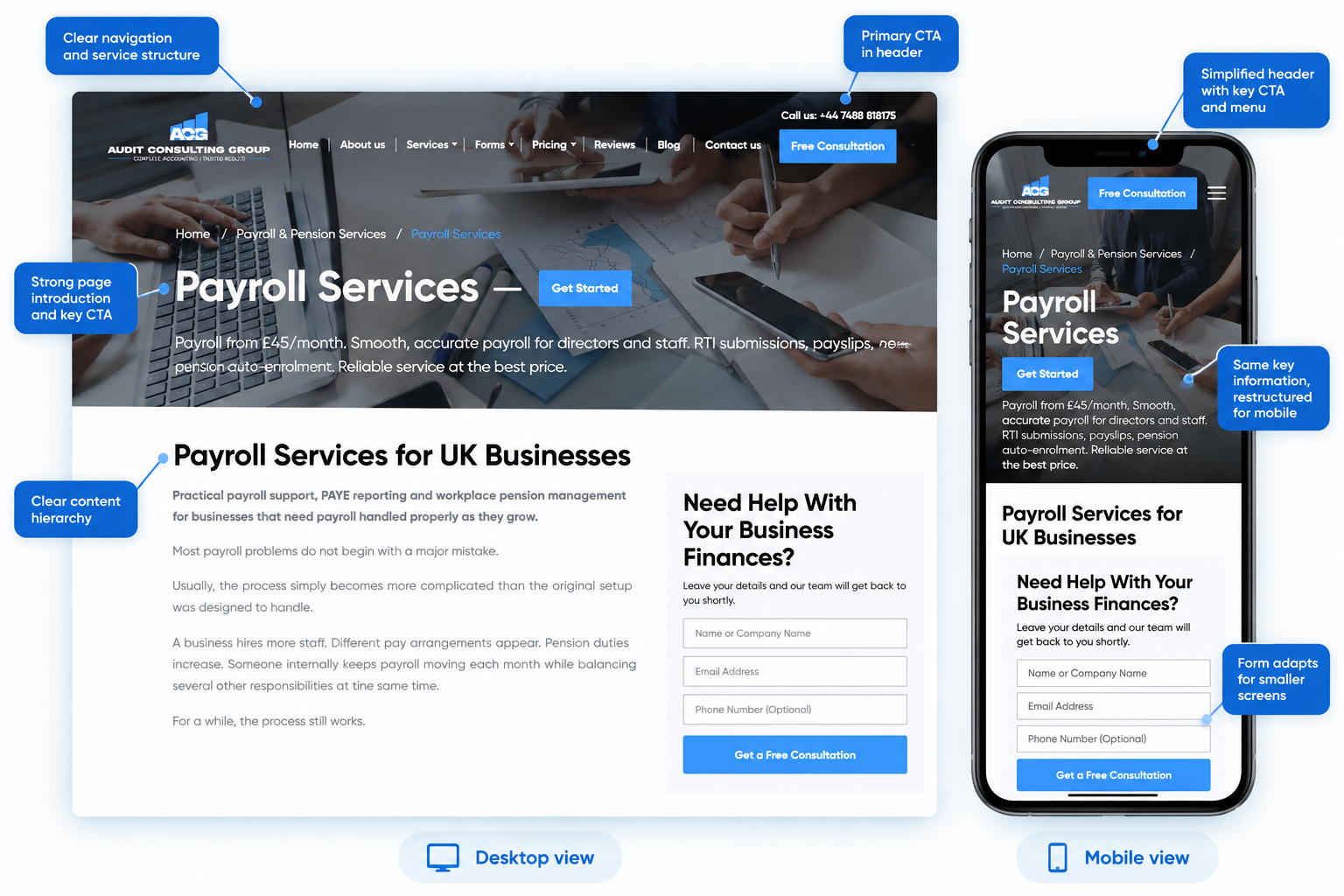
What to notice: the mobile version should preserve the important information and actions while changing the way navigation, spacing and content are presented for a narrower screen.
What Our B2B Website Design Service Can Include
 Requirements and Business Context
We establish what the website needs to communicate, the important audiences and stakeholders, and the commercial role different areas of the site need to perform.
Stakeholder and Buyer Planning
We identify the main questions and information needs that should influence page structure and visitor journeys.
Information Architecture
We organise services, capabilities, supporting content and navigation so that related information forms a coherent website rather than a collection of disconnected pages.
UX and Wireframing
Where appropriate to the project, wireframes can be used to establish page hierarchy, content relationships and key actions before detailed visual design.
Visual UI Design
Page interfaces are designed to create a consistent visual hierarchy across the website while supporting the information and actions that matter on each page.
Responsive Design
Layouts are considered across different screen sizes so that navigation, content priority and important actions remain usable beyond desktop.
Content Structure
We define how key content types should be presented within the page hierarchy. Copywriting or content production should be agreed separately where required.
Development and CMS Implementation
Where development is included in the agreed project scope, the approved designs can be implemented as a working website with appropriate content-management functionality.
Forms and Conversion Paths
Enquiry routes and forms can be planned around the actions visitors need to take rather than being treated as isolated page elements.
Depending on project scope, additional requirements can include content migration, analytics implementation, integrations, multilingual structure or other agreed functionality.
SEO, Performance and Accessibility Foundations
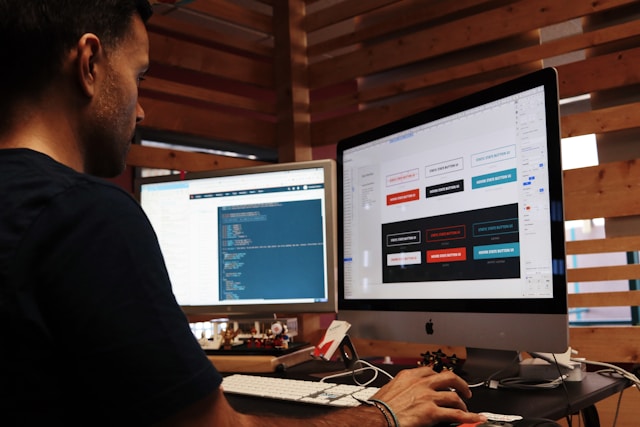 Website design decisions can also support the foundations needed by search engines and users. This includes logical heading hierarchy, crawlable navigation, internal-linking opportunities, responsive usability and performance-aware interface decisions.
Accessibility considerations can also inform hierarchy, interaction and presentation. Specific compliance requirements should be defined and agreed separately where applicable.
Businesses requiring a broader search strategy should use the dedicated service rather than treating website design as a substitute for ongoing SEO work.
Expert Insight: Structure the Website Around Buyer Questions
What we see: one of the easiest ways for a B2B website to become difficult to navigate is to organise it entirely around the company’s internal structure. That structure may make perfect sense to the team, but a prospective buyer may arrive with a problem, requirement or evaluation question rather than the name of the department responsible for it.
Why it matters: if visitors have to translate their own need into your internal terminology before they can find relevant information, unnecessary friction is introduced into the journey.
What we recommend: map important journeys as Stakeholder → Question → Relevant Content → Proof → Next Action. Internal business structure still matters, but it should not be the only logic shaping navigation and page relationships.
Discuss Your Requirements
If your B2B website needs to communicate a complex offer to several audiences or decision-makers, we can review the requirements and identify an appropriate design and delivery scope.
How a B2B Website Project Moves Forward
 1. B2B Requirements
PLD: establish the website’s role, important audiences and project requirements. Client: provide business context, existing materials and priorities. Output: an agreed direction for the project.
2. Website Architecture
PLD: organise the main page groups, navigation and content relationships. Client: review the proposed structure against the business and buyer needs. Output: an agreed website structure.
3. UX Direction
PLD: define important page hierarchies, journeys and actions, using wireframes where appropriate. Client: review whether the proposed experience reflects the required information and priorities. Output: an approved UX direction.
4. Visual Design
PLD: develop the visual interface and responsive design direction. Client: review and approve the agreed designs. Output: approved page designs for the agreed scope.
5. Development Where Included
PLD: implement approved designs and agreed functionality where development forms part of the project. Client: provide required content, access and feedback. Output: the implemented website within the agreed development scope.
6. Review and Launch
PLD: complete the agreed review and launch preparation. Client: provide final approvals and any required launch information. Output: launch of the agreed website once required checks and approvals are complete.
What You Receive
| Deliverable | What It Provides | Status |
|---|---|---|
| Website architecture | Agreed structure for key pages, navigation and content relationships. | Core |
| Visual UI design | Designed page interfaces for the agreed project scope. | Core |
| Responsive design | Design treatment for relevant screen sizes and responsive behaviour. | Core |
| UX layouts or wireframes | Page hierarchy and journey planning before detailed visual design. | Scope-dependent |
| Website development | Implementation of approved designs as a working website. | Scope-dependent |
| CMS implementation | Content-management functionality appropriate to the agreed build. | Scope-dependent |
| Forms and enquiry routes | Agreed forms and actions required by the website. | Scope-dependent |
| Content migration | Transfer of agreed existing content into the new structure. | Scope-dependent |
| Analytics implementation | Agreed analytics implementation where included in the project. | Scope-dependent |
| Testing and launch support | Agreed review and launch activities where PLD is delivering the website build. | Scope-dependent |
Choose the Right B2B Website Engagement
The right engagement depends partly on whether your organisation already has the resources to build the approved designs.
| Consideration | Design Only | Design + Development |
|---|---|---|
| Best suited to | Businesses with an internal or external development resource ready to implement the designs. | Businesses that want design and agreed implementation handled within the project. |
| Design and UX | Included within the agreed design scope. | Included within the agreed design scope. |
| Development | Handled by your development team or another provider. | Included where defined in the agreed PLD scope. |
| Client coordination | Requires handover and coordination with the implementation team. | Reduces the design-to-development handover between separate providers. |
| Scope | Focused on planning, UX and visual design deliverables. | Extends into agreed website implementation and launch activities. |
B2B Website Design Pricing
B2B Website Design starts from £1,200.
The final project cost depends on the amount of planning, design and implementation required. A smaller design engagement and a larger multi-service B2B website do not require the same scope.
| Cost Factor | Why It Matters |
|---|---|
| Number of pages and page types | More distinct templates or page requirements increase the amount of design and implementation work. |
| Information architecture | Complex services, audiences or content relationships can require more planning before page design begins. |
| UX and wireframing | Projects requiring detailed journey planning or wireframes involve additional UX work. |
| Visual design complexity | The number and complexity of unique interface patterns influence design scope. |
| Content readiness | Projects with established content can move differently from projects that require substantial content organisation or migration. |
| Development | Design-only and design-plus-development engagements have different scopes. |
| CMS and functionality | Forms, content-management requirements and other agreed functionality affect implementation scope. |
| Migration, integrations or multilingual requirements | These can add additional work where they form part of the agreed project. |
The £1,200 figure is a starting price, not a fixed price for every B2B website project. The appropriate scope and quotation depend on the requirements.
How Long Does a B2B Website Project Take?
The required timeline depends on the project rather than a single standard duration. Important factors include the number and type of pages, information-architecture work, content readiness, stakeholder feedback and approvals, development complexity, agreed functionality or integrations, migration requirements and testing.
These requirements should be established during project scoping before a delivery plan is agreed.
Related Website Services
Website Design
For broader website design requirements that are not specifically centred on B2B buying journeys and stakeholder complexity.
Company Website Design
For organisations primarily focused on presenting the company, its services, audiences and commercial information within a clear corporate website structure. COMPANY WEBSITE DESIGN
Website Redesign
For businesses whose main requirement is replacing or restructuring an existing website that no longer meets their needs.
Web Development
For projects where implementation, functionality and technical delivery are the primary requirement. WEB DEVELOPMENT
WordPress Web Design
For businesses specifically looking for a website design service centred on WordPress. WORDPRESS WEB DESIGN
B2B Website Design FAQs
Let's Discuss Your ProjectTell us a little about what you’re looking for, and our team will be in touch to discuss how we can help.
Tell us a little about what you’re looking for, and our team will be in touch to discuss how we can help.
What is B2B website design?
B2B website design is the planning and design of websites for businesses that sell products, services or expertise to other organisations. It often needs to account for several stakeholders, longer evaluation journeys, detailed service or capability information and different proof requirements.
How is B2B website design different from general website design?
The fundamental design principles remain important, but B2B projects often place greater emphasis on stakeholder journeys, complex propositions, service or capability structure, supporting evidence and the information buyers need during evaluation.
How much does B2B website design cost?
Prime Lion Digital’s B2B Website Design service starts from £1,200. Final cost depends on factors such as page types, information architecture, UX requirements, visual complexity, development, functionality, migration and other agreed project requirements.
How long does a B2B website project take?
There is no single timeline that applies to every project. Timing depends on factors including project size, content readiness, stakeholder approvals, design requirements, development scope, integrations, migration and testing.
Can you redesign our existing B2B website?
Yes, an existing website can form the starting point for a new project. Where redesign is the primary requirement, the dedicated service provides the more specific route.
Do you provide B2B website design and development?
Development can be included where it forms part of the agreed project scope. Businesses that already have a development resource can also discuss a design-focused engagement.
Is SEO considered during B2B website design?
SEO-aware foundations such as logical hierarchy, crawlable navigation and internal-link opportunities can be considered during website planning and design. A complete ongoing SEO strategy is a separate service.
Can our marketing team update the website after launch?
Where a content management system is included, the editing requirements and content-management approach can be agreed as part of the project scope.
Scope Your B2B Website
If you are planning a new B2B website, start by outlining your services, audiences, current website situation and what the new site needs to support. Prime Lion Digital can use that information to review the requirements and define an appropriate scope.