Video Strategy & Concepts Services in UK
Tell us a little about what you’re looking for, and our team will be in touch to discuss how we can help.
Video Content Strategy & Creative Concept Development — From £500
A good video starts with a clear decision about what it needs to communicate, who needs to see it and what should happen next. Prime Lion Digital helps UK businesses develop video strategies and creative concepts before committing to filming, animation or editing.
Whether you have a rough idea, an internal brief or a campaign that needs a stronger direction, our video strategy and concept development service helps turn objectives into a creative approach that can be reviewed, approved and prepared for production.
Starting price: From £500. The final scope and quotation depend on the objectives, research, creative development and deliverables required.
Discuss Your Video Strategy | Explore Pre-Production Services
Why Video Projects Need a Clear Strategy Before Production
It is possible to produce an attractive video that fails to communicate the right message. The difficulty is not always the camera work or editing. Sometimes the project starts without agreement on the audience, the purpose of the video or the action the viewer should take.
A video marketing strategy gives the creative work a commercial direction. Creative concept development then turns that direction into a format, narrative and visual approach that can be assessed before production resources are committed.
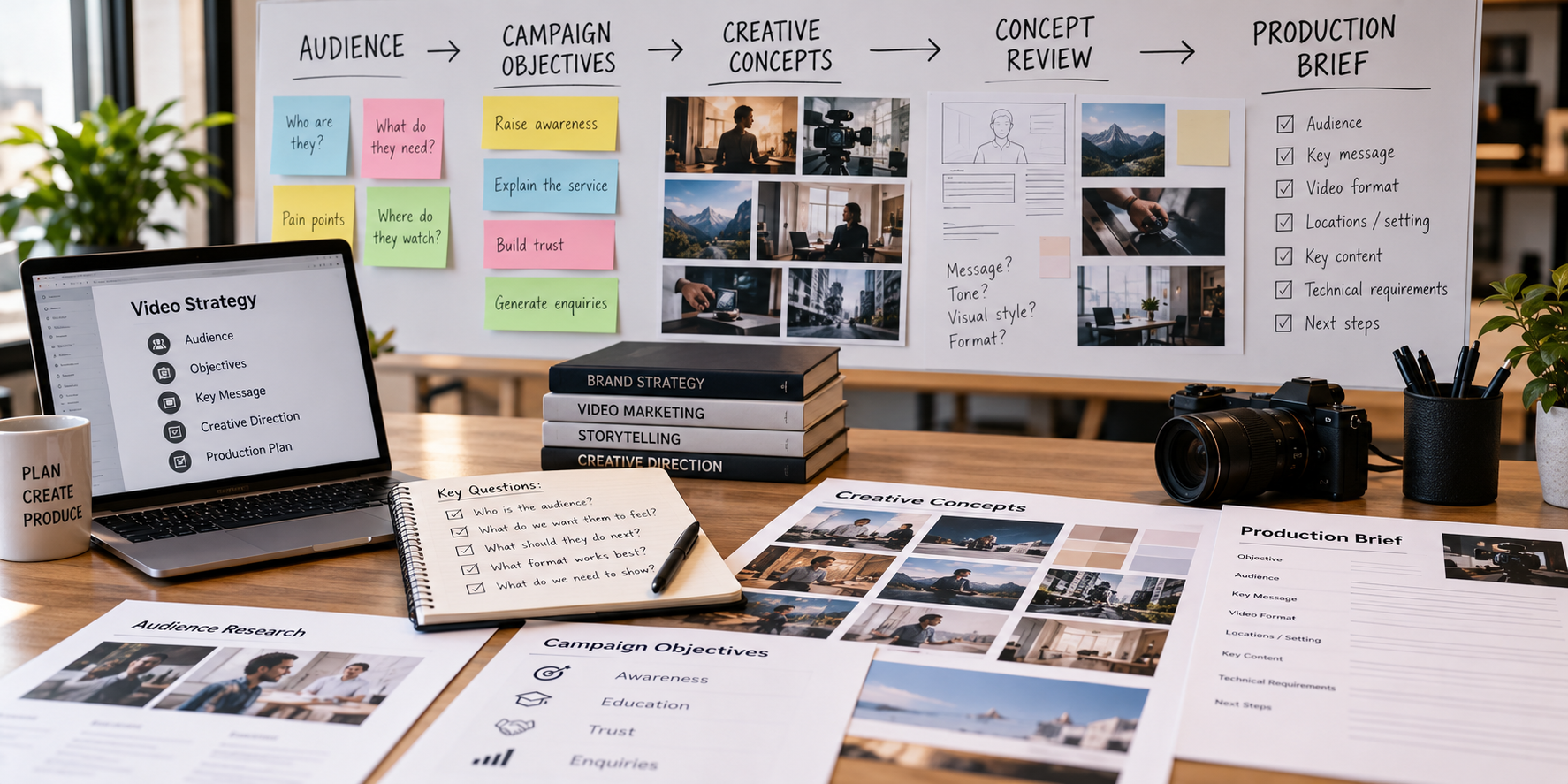
That distinction matters. A strategy explains why the video should exist and what it needs to achieve. A concept shows how the message could be expressed. A production brief translates the chosen direction into practical requirements.
What Can Go Wrong Before a Video Is Filmed?
The business objective is too broad
A brief such as “make a promotional video” does not explain whether the priority is awareness, product understanding, recruitment, enquiries or another outcome. Without that decision, creative ideas may be judged mainly on personal preference.
The intended audience is not clearly defined
A video for a procurement manager considering a complex service may need a different approach from a short social video introducing a consumer product. Audience needs influence the message, pace, evidence and creative format.
Different stakeholders expect different messages
Sales, marketing and leadership teams may each have legitimate priorities. Without a shared hierarchy, the video can become overloaded with competing messages.
Production decisions are made before the concept is tested
Choosing locations, filming styles or animation techniques too early can constrain the creative solution. Strategic planning helps establish which production choices are justified by the communication goal.
Success has not been defined
Video performance cannot be judged meaningfully without understanding its intended role. The relevant indicators may differ depending on whether the video is designed to explain a product, support a sales conversation or introduce a brand.
Signs Your Video Idea Needs More Development
You may recognise one or more of these situations:
| What you are seeing | What may need investigating |
|---|---|
| Several creative ideas but no clear choice | Whether the objectives and evaluation criteria have been agreed |
| Repeated changes to the brief | Whether the audience, message and approval responsibilities are clear |
| Videos that feel disconnected from one another | Whether there is a consistent campaign or brand narrative |
| Views without the enquiries you expected | The offer, audience, distribution, landing page and creative message |
| Uncertainty about filming requirements | Whether the selected concept is sufficiently developed for production planning |
These symptoms do not prove that the creative concept is the problem. For example, a video may explain a service clearly but reach the wrong audience, or send interested viewers to a page that does not support the next step. The purpose of strategic diagnosis is to identify which decisions actually need attention.
Our Video Strategy & Creative Concept Development Services
Video Content Strategy
We help define the role of video within a business or campaign objective. This can involve examining the intended audience, the main communication challenge, the desired viewer response and how the video will be used.
The result is a clearer basis for deciding which message, format and creative direction deserve investment.
Creative Video Concepts
Creative concept development translates the strategy into a visual and narrative direction. Depending on the brief, this may involve exploring different approaches, such as an interview-led story, a product demonstration, a problem-and-solution narrative or a more expressive brand concept.
Concepts can be considered in relation to their clarity, originality, audience relevance and practical production requirements.
Video Concept Brief Development
A video concept brief brings the agreed direction together in a form that can be reviewed by stakeholders and used by a production team. It may describe the audience, central message, intended format, narrative approach, visual references and important production considerations.
Campaign and Platform Direction
Where relevant, video strategy can consider how the core message should work across different channels. A LinkedIn audience may require a different opening and explanation from a short-form social audience, even when the business objective is related.
Detailed filming, editing, platform asset production and campaign management are separate activities unless expressly included in the agreed project scope.
When Is Video Strategy & Concept Development Useful?
Corporate and B2B Communication
A business preparing a corporate video may need to decide whether its strongest message is its expertise, customer experience, people or working process. The strategy establishes the priority before a filming format is selected.
Product Launches
A product launch may benefit from a concept that demonstrates a practical use, explains a technical advantage or introduces a broader brand story. The right approach depends on what the intended buyer already understands.
Recruitment and Employer Branding
Recruitment videos often need to communicate a credible picture of the working environment. A concept may prioritise employee perspectives, real workplace activity or a clear explanation of the role.
Social Media Campaigns
For a social media campaign, the strategic task may involve defining the message hierarchy, opening hook and relationship between shorter videos. Platform-specific production is addressed separately through our Social Media & Digital Video services.
How We Develop a Video Strategy and Creative Concept
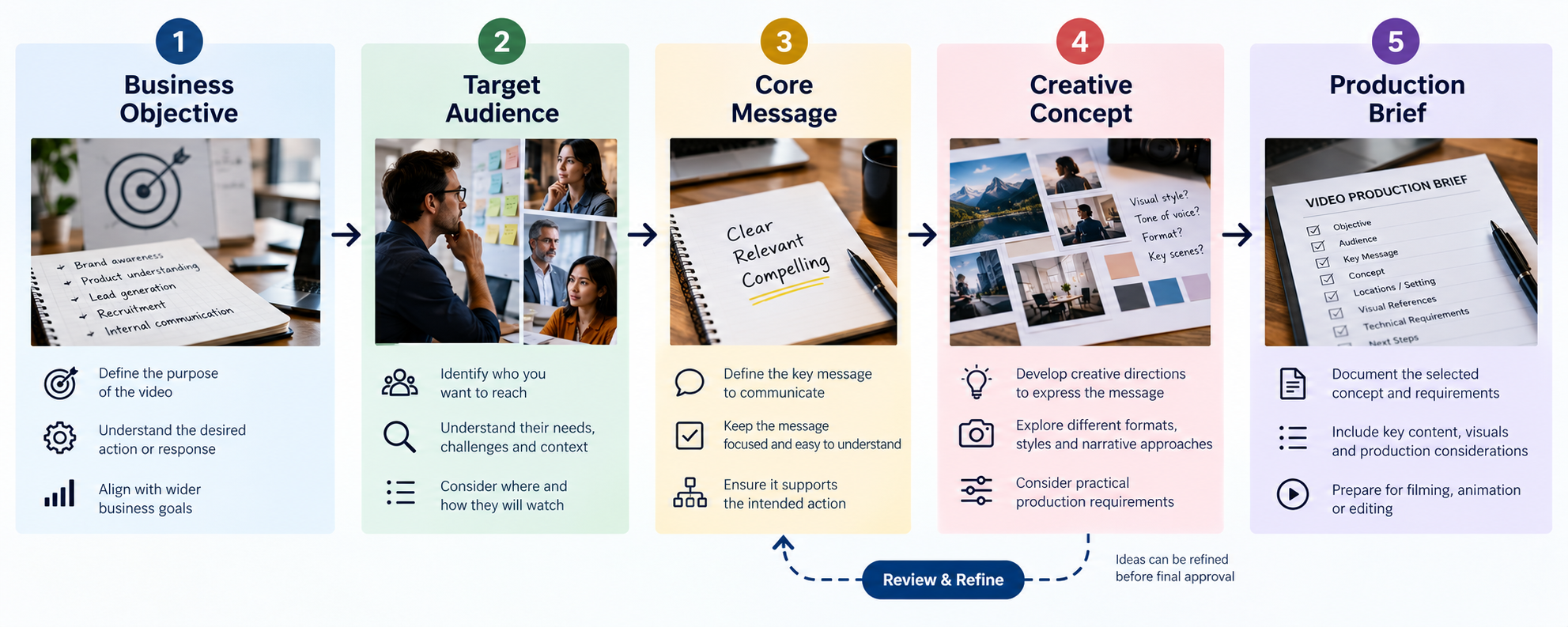
1. Define the Communication Objective
We begin with the decision the video needs to support. Is the viewer expected to understand a complex service, recognise a problem, trust a business or take a specific action?
The objective influences what information deserves priority and which creative approaches may be unsuitable. The working output is an agreed direction for the video’s purpose and intended response.
2. Examine the Audience and Context
The next consideration is what the audience already knows, what they need explained and what might prevent them from engaging. A technical buyer may value a clear demonstration, while a first-time customer may need reassurance or a simpler introduction.
Where appropriate, we also consider where the video will appear and what viewers are likely to be doing when they encounter it.
3. Develop Creative Directions
With the strategic requirements established, we can develop creative routes that express the message differently. A concept may use direct explanation, a human story, a visual demonstration or a combination of techniques.
Creative options should be meaningfully different, rather than small variations of the same idea. The number and depth of concepts depend on the agreed scope.
4. Evaluate the Concepts
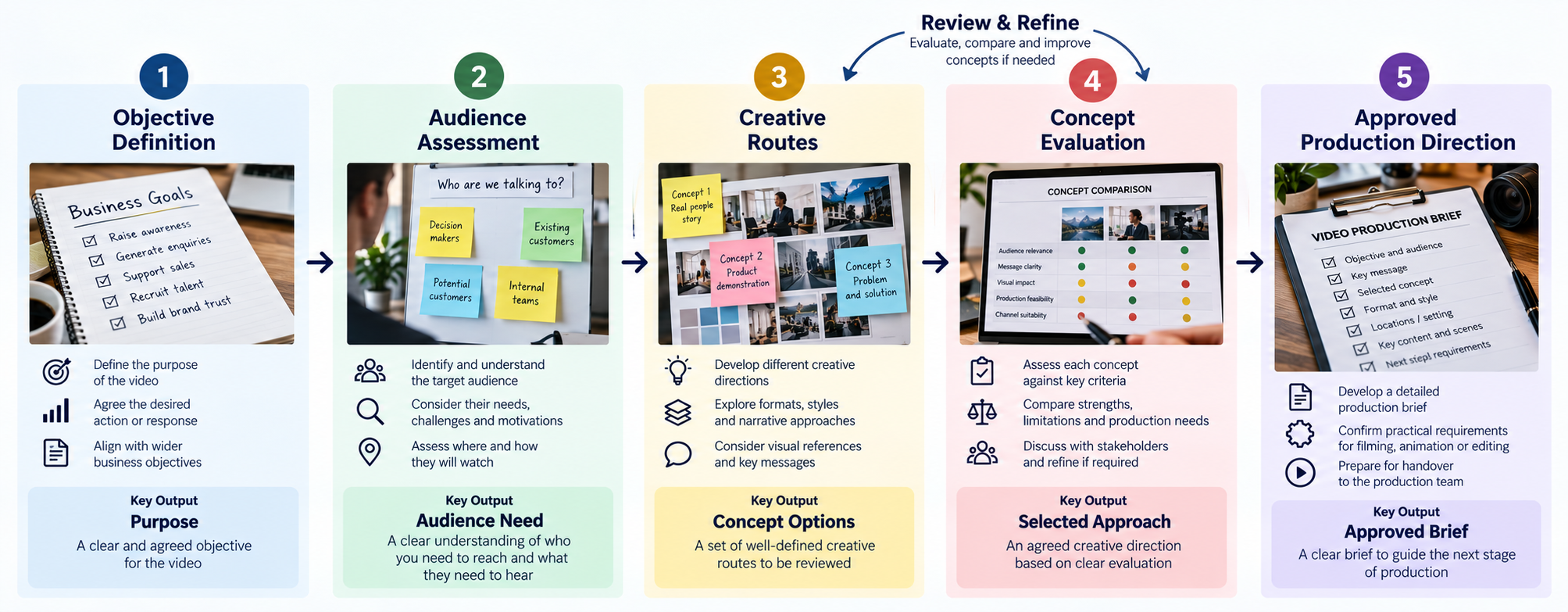
Concepts are assessed against the communication objective, audience relevance, message clarity, practical feasibility and production implications.
A visually ambitious idea is not automatically the strongest. If a simpler approach communicates the product more effectively and is easier to deliver within the available resources, it may be the better recommendation.
5. Prepare the Selected Direction for Production
Once a direction has been selected, the agreed concept can be developed into a clearer brief for production planning. The detail depends on the project and may include visual references, narrative structure, key messages and requirements for filming or post-production.
Stakeholder review helps confirm that the intended message and creative direction are understood before the project moves forward.
How Do You Choose the Right Video Concept?
Concept selection should be based on the job the video needs to do, not simply which idea looks most impressive in a presentation.
| Evaluation criterion | Key question | Why it matters |
|---|---|---|
| Audience relevance | Will the intended viewer recognise why this matters? | Helps prevent creative work from becoming disconnected from buyer needs. |
| Message clarity | Can the main point be understood without excessive explanation? | Protects the central communication objective. |
| Visual suitability | Does the idea benefit from video rather than another format? | Ensures the medium is being used for a meaningful reason. |
| Production feasibility | Can the approach realistically be produced with available resources? | Helps identify practical constraints before production. |
| Channel suitability | Does the format make sense where the audience will encounter it? | Supports appropriate pacing, structure and presentation. |
| Next-step alignment | Does the concept support the intended viewer action? | Connects the creative idea to its commercial purpose. |
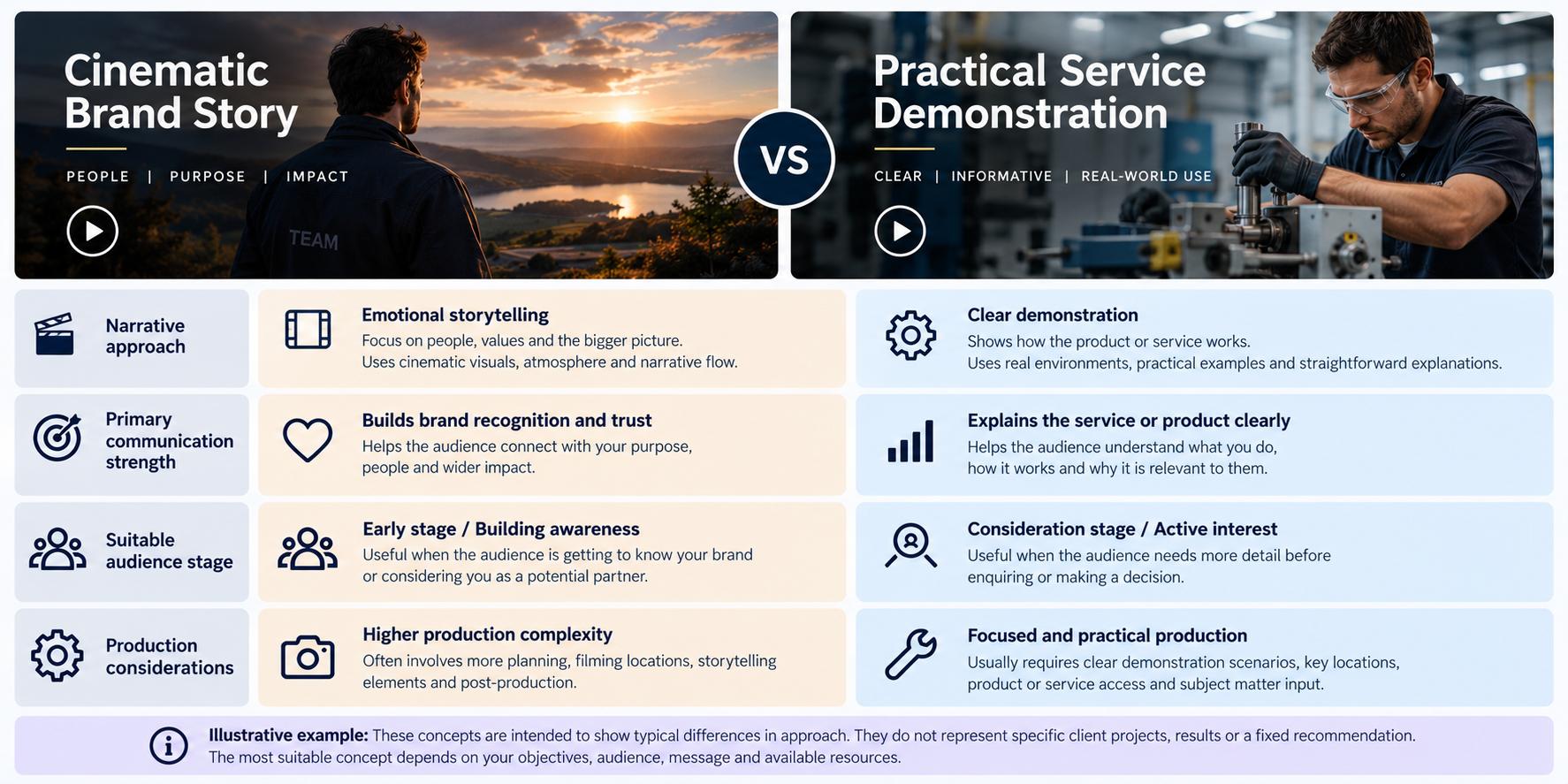
Example: Choosing Between Two B2B Video Concepts
Imagine a specialist engineering company wants a video to help prospective buyers understand an unfamiliar service.
Concept A: Cinematic Brand Story. This could communicate the scale of the business, introduce its people and create a strong visual impression. It may be useful when the priority is brand recognition or establishing confidence.
Concept B: Practical Service Demonstration. This could show the process, explain common customer questions and illustrate what the service involves. It may be more suitable when buyers need technical understanding before making an enquiry.
Neither concept is universally better. The decision depends on the audience, their stage of consideration and the purpose of the video.
Have a Video Idea but Need to Decide Whether It Works?
Share your intended audience, business objective and current concept. We can discuss whether the idea needs refining, a different creative direction or a more detailed production brief.
What Will You Receive?
Deliverables are defined in the agreed quotation. Depending on the size and nature of the project, they may include the following:
| Potential deliverable | What it contains | How it helps |
|---|---|---|
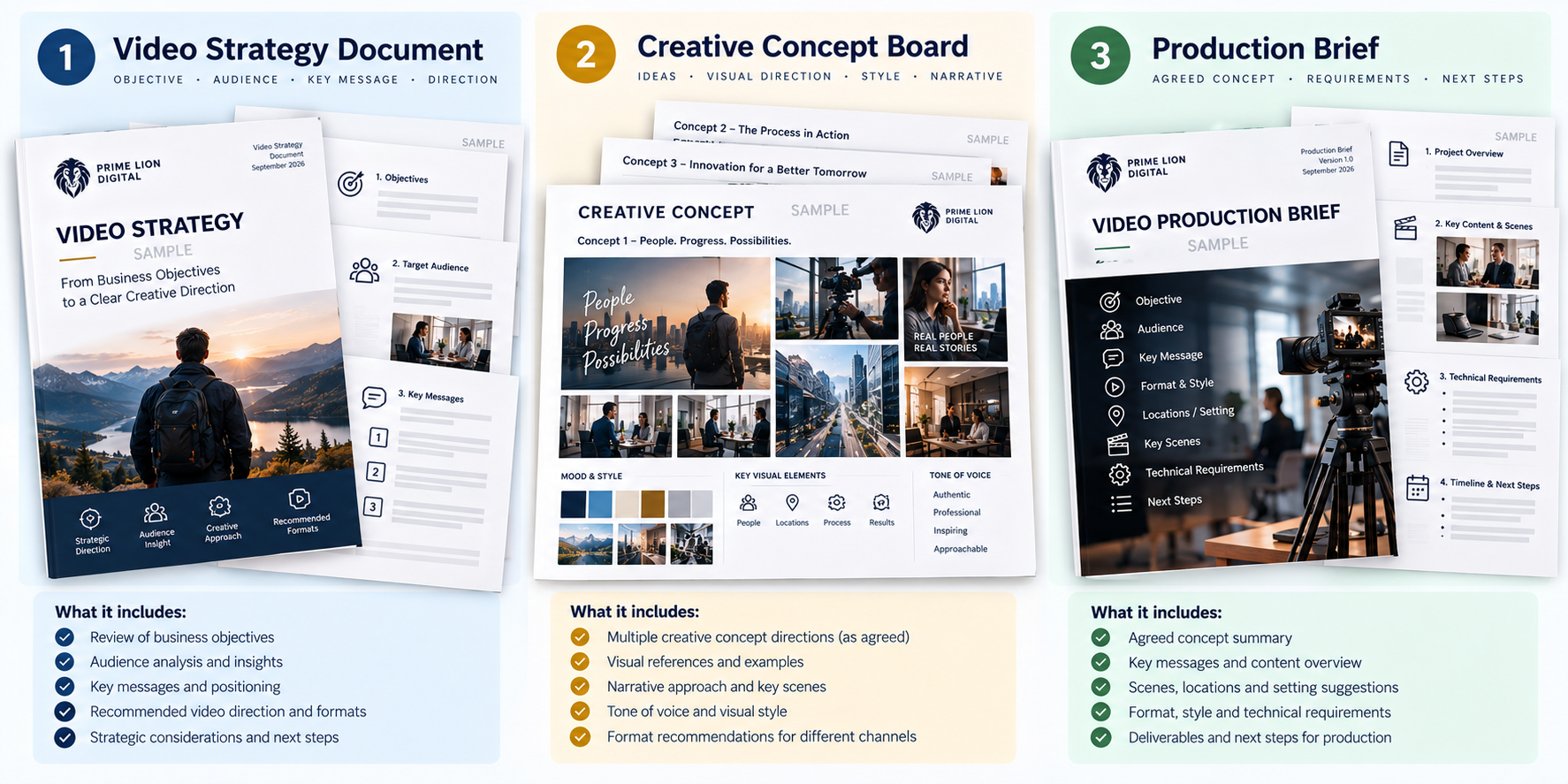
| Video Strategy Document | Objective, audience, key message and recommended video direction | Provides a shared strategic reference for decision-making |
| Creative Concept Presentation | Agreed creative approach, narrative direction and visual references | Helps stakeholders review and approve the proposed concept |
| Video Content Plan | Proposed themes, formats or content priorities where required | Connects individual videos to a wider communication plan |
| Production Brief | Selected concept, intended format, key content and practical considerations | Supports preparation for filming, animation or editing |
| Measurement Framework | Relevant objectives and suggested indicators where included | Clarifies how the video’s intended role may be assessed |
| Script or Storyboard | Written narrative or visual sequence where separately scoped | Develops the selected concept into greater production detail |
Important: The table describes possible outputs, not a fixed package included at £500. The exact documents, formats, number of concepts and revision arrangements are confirmed before work begins.
Video Strategy vs Creative Concept vs Production Brief
| Document or stage | Main question answered | Typical focus |
|---|---|---|
| Video Strategy | Why are we making the video and for whom? | Objectives, audience, message and intended response |
| Creative Concept | How should the message be expressed? | Narrative, visual approach, format and creative direction |
| Production Brief | What needs to be prepared to produce it? | Approved direction, content requirements and production considerations |
These elements are connected, but they are not interchangeable. A production team can work more confidently when the strategic and creative decisions have already been made.
From Creative Direction to Finished Video
Video strategy is most useful when its decisions can guide real production work. The approved concept should help the production team understand what to communicate, which scenes or visual elements are important and how the result should be used.
Explore the Prime Lion Digital portfolio for examples of creative and digital work. Where a project is presented as evidence of this specific strategy service, its strategic scope and PLD’s involvement should be verified.\
‘
Expert Insight: The Most Impressive Idea Is Not Always the Right One
A creative concept should be judged against the audience’s decision, not only its visual appeal.
Consider a B2B company selling a technical service. A beautifully filmed brand story might establish credibility and give viewers a sense of the people behind the business. Yet a prospective buyer who is still trying to understand the service may need a direct demonstration, a clear explanation of the process or answers to practical questions.
The brand story is not necessarily wrong. It may simply serve a different purpose.
This is why creative concept development should include trade-offs. A concept can be original but difficult to produce, visually appealing but unclear, or persuasive for one audience while unsuitable for another.
The useful question is not “Which idea looks best?” but “Which idea communicates the right message to the right audience, in a form that can realistically be produced?”
How Much Does Video Strategy & Concept Development Cost?
Video Strategy & Concepts services start from £500.
The final quotation depends on the agreed scope. Factors may include:
- The complexity of the business objective and intended audience.
- The level of research or analysis required.
- The number and depth of creative directions to be developed.
- The complexity of the video format or campaign.
- The amount of scripting, storyboarding or production planning requested.
- The number of stakeholders and agreed review requirements.
The £500 figure is the confirmed starting price, not a promise that every item described on this page is included in a single entry package. We will define the specific work and deliverables in the quotation.
How Long Does the Strategy and Concept Stage Take?
Timing depends on the complexity of the brief, availability of relevant information, the number of creative directions and how quickly feedback and approvals can be provided.
A focused concept review may involve less work than a strategy covering several audiences or a multi-video campaign. We will discuss the required scope and proposed delivery schedule before work begins rather than promise a fixed timeframe for every project.
Related Video Production Services
Once the strategy and concept are agreed, the next service depends on the type of video you need.
- Pre-Production Services — for broader preparation before filming.
- Business Video Production — for producing videos that support business communication and marketing.
- Corporate Filming — for filming interviews, workplaces, events and other corporate content.
- Social Media & Digital Video — for producing video content designed for digital channels.
- Video Production Services — for exploring the wider range of production options.
Frequently Asked Questions
What is included in video strategy and concept development?
The service can cover strategic direction, audience and message development, creative concept work and production briefing. Exact activities and deliverables depend on the agreed quotation.
Do I need a video strategy before filming?
A formal strategy document is not necessary for every video, but the objective, audience and creative direction should be clear before major production decisions are made. The amount of planning required depends on the project.
Can you improve an existing video idea?
Yes, the service can focus on reviewing and refining an existing idea rather than developing a completely new direction. The review may consider message clarity, audience suitability and production feasibility.
How much does video strategy and concept development cost?
Our Video Strategy & Concepts service starts from £500. The final cost depends on the complexity of the work and the agreed deliverables.
How many video concepts will I receive?
The number of concepts is agreed in the project scope. Some briefs require refinement of one direction, while others may benefit from comparing several distinct creative approaches.
Can you create a strategy for LinkedIn, YouTube or Instagram?
Platform considerations can form part of the strategic brief where relevant. Detailed production of platform-specific assets is separately scoped unless included in the quotation.
Can my existing video production team use the concept?
Yes. An agreed concept and production brief can be prepared to support an internal or external production team. The level of detail required should be established before the handover.
Who owns the creative concepts and documents?
Ownership, licensing and permitted use should be confirmed in the project agreement. The terms may depend on the nature of the work and any third-party materials involved.
Develop a Video Concept That Has a Clear Purpose
If you are planning a corporate video, product demonstration or marketing campaign, the first decision should be what the video needs to communicate and how its creative direction will support that purpose.
Tell us about your business objective, intended audience, current idea and any production requirements. Prime Lion Digital can discuss an appropriate video strategy and concept development scope, starting from £500.